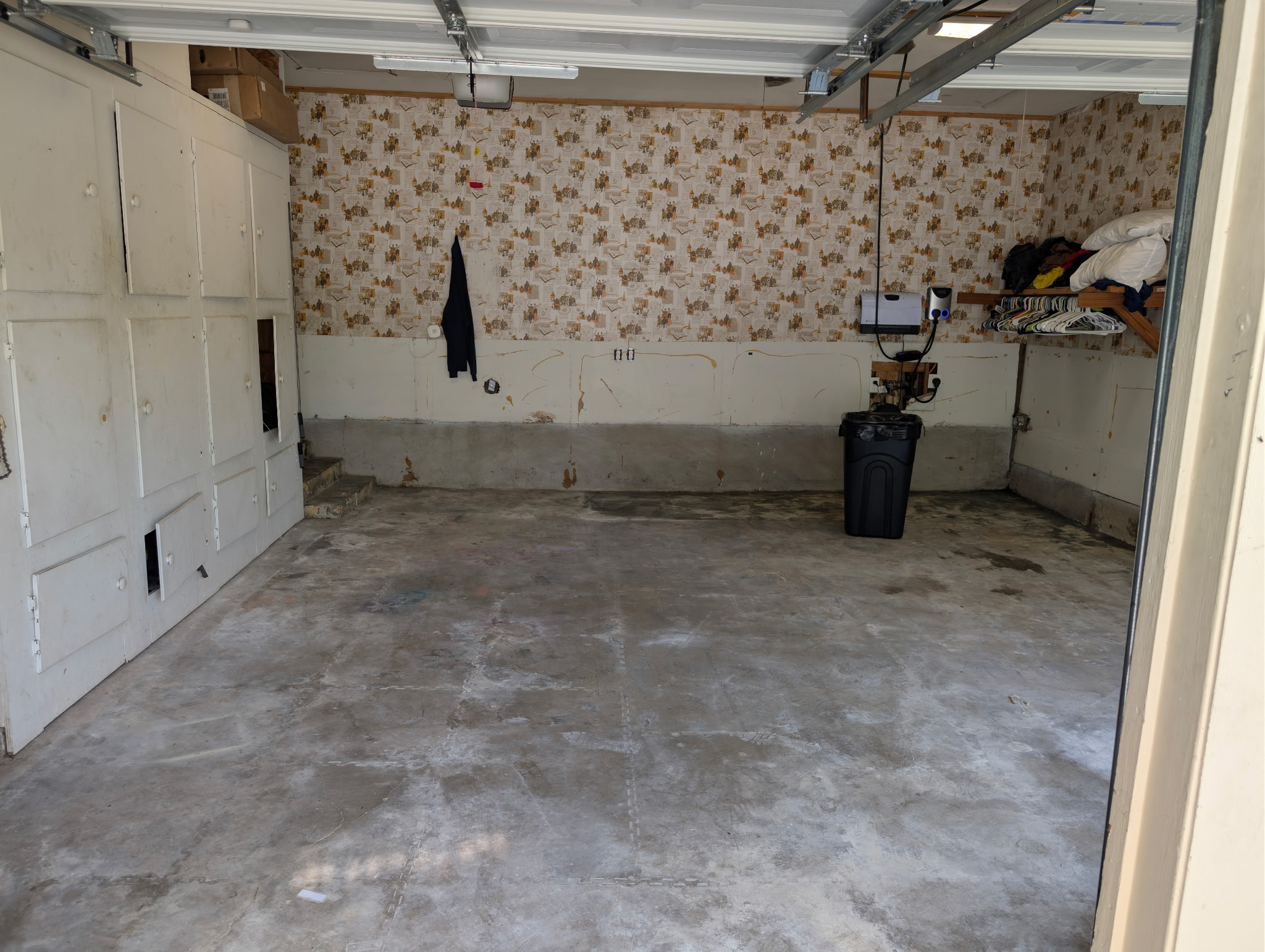
The 28-day rule tells you when concrete has reached strength, not when it is dry enough to coat. A new Trinity Falls or Painted Tree slab can still be pushing moisture vapor months later, and it almost always carries a builder cure-and-seal compound that blocks bonding until it is ground off. The honest answer is to move in, let the slab go through a season, then test and coat.
I get this call about twice a month now, usually from someone who just closed on a house in Trinity Falls or Painted Tree. The garage is empty, the slab is clean, and it will never be this easy to work in again. Everybody wants to know the same thing. Concrete is cured at 28 days, right? So can we coat it next weekend?
What 28 Days Actually Measures
Twenty-eight days is a strength benchmark. It is when a concrete mix has reached most of its designed compressive strength and the structural engineer can sign off. It says nothing about how much water is still working its way out of that slab, and water is the only thing a coating cares about.
A residential slab in Collin County is four inches thick and poured directly on grade with a vapor barrier under it. Every bit of mix water that is not chemically locked into the cement has to travel up and out through the top surface, because that is the only direction available. That process takes months, not weeks. Rule of thumb in the trade is roughly a month per inch under decent drying conditions, and a slab poured in a wet North Texas spring in a house that has not been climate controlled yet does not have decent drying conditions.
Trap that vapor under a coating and it collects at the bond line until the pressure lifts the coating off the concrete. You get bubbles, then soft spots, then a patch that peels up like a sticker. The product did not fail. The slab was still breathing.
Testing Instead of Guessing
This is why I test rather than count days on a calendar. There are two methods worth knowing about. A calcium chloride test sets a small dish of salt on the slab under a sealed dome for three days and weighs how much moisture it pulls out of the surface. Relative humidity probes go further: we drill a small hole, drop a sensor down into the slab, and read the humidity inside the concrete itself. That in-slab reading is the more honest one, because it tells you what is still coming rather than just what has already arrived.
Coating manufacturers publish limits for both numbers. When a slab reads over the limit, we either wait or install a moisture-mitigating primer built for that condition. What we never do is coat a wet slab with a standard system and hope. That is a coin flip with someone’s garage.
The Builder Sealer Nobody Mentions
Here is the part that surprises people most. Almost every production builder sprays a cure-and-seal compound on the slab right after the pour. It keeps the concrete from drying too fast, which is genuinely good for the concrete. It is also a membrane sitting on the exact surface an epoxy needs to bond into, and it does not wash off. You cannot see it, and a hose will not tell you it is there.
That film has to be mechanically removed. We diamond-grind the whole slab, which takes the sealer off and opens the pores so the primer keys into the concrete instead of clinging to a coating on top of a coating. Any crew that shows up at a new build with an acid wash and a roller is putting your floor on top of the builder’s sealer, and that bond is only as strong as the film underneath it.
Why the Builder Paint Peels
You have probably walked into a new garage with a thin gray painted floor and thought it looked sharp. Give it eighteen months. That coating is usually a single-component paint rolled straight over the cure-and-seal to make the house show well, with no grinding and no moisture testing. It peels at the door line first, then wherever a tire sits hot after a summer drive. It was never built to last, and honestly it was never priced to. It is a finish detail, not a floor system.
Green Concrete Moves in the First Year
New slabs also shrink as they dry, and shrinkage puts hairline cracks in the surface. That is normal concrete behavior, not a defect, and on McKinney’s clay soil the first wet-to-dry season adds a little movement on top of it. Coat at three weeks and every one of those hairlines forms under your floor and telegraphs through.
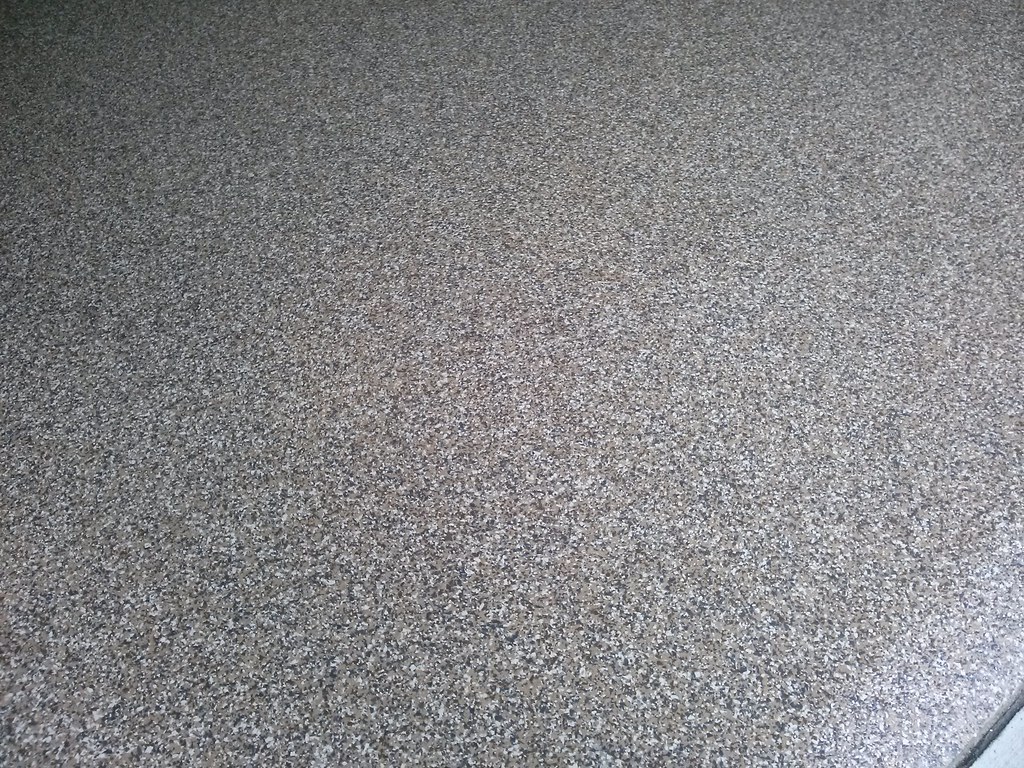
Wait a season and most of that early movement has already happened where you can see it. Then we fill and detail the cracks before anything goes down, and a flake broadcast does the rest. Flake is not just a color choice; the visual texture of a heavy broadcast breaks up the eye so a fine line never reads as a flaw. On a first-year slab, that camouflage is doing real work.
The Sequencing I Recommend
Move in. Live in the house. Let the HVAC run through a summer and a winter so the slab dries under real conditions and does its early shifting. Somewhere past the six month mark, we come out, put a probe in the slab, read a real number, and coat it with confidence. That timeline is not me stalling. Waiting a few months costs nothing. Grinding off a failed coating and starting over costs the whole job twice, and I would rather you spend that money once.
Cody spent ten years building live-edge resin tables before he ever coated a garage, and the habit that came out of that work is simple: the material tells you when it is ready, and you do not argue with it. If you are in a new build and wondering where your slab stands, the McKinney garage floor coatings page walks through the full system, and the gallery shows finished work on local slabs.
New Construction Slab FAQ
Can I coat my new garage floor at 28 days?
You can, but you are betting on moisture you have not measured. Twenty-eight days is a strength milestone, not a dryness milestone. A four-inch slab typically needs several months of real drying, and a builder cure-and-seal still has to be ground off first. Test the slab and you will know instead of guessing.
How do you know if my Trinity Falls slab is dry enough?
We test it. A calcium chloride kit measures moisture coming off the surface over three days, and an in-slab relative humidity probe reads the humidity inside the concrete. Both have published limits from the coating manufacturer. If the slab reads high, we either wait or use a moisture-mitigating primer rated for that number.
Why do builder-painted garage floors peel?
They are usually a thin single-component paint rolled over the builder’s cure-and-seal with no grinding and no moisture testing. The bond is only as good as the film underneath it, so the paint lifts at the door line and under hot tires. Removing it means grinding the slab back to bare concrete before a real system goes down.
McKinney New Construction Floors
Cody will read your slab, test the moisture, and tell you straight whether it is ready or worth waiting on. No pressure to coat before it makes sense.
Coat My Floor Talk to Us: (972) 369-6302