Every crack in a Carrollton slab gets sorted into one of three piles before anything is mixed. Static cracks get chased open and filled rigid. Cracks that still move get a flexible fill and an isolation detail. Live joints get honored as joints. Guess wrong and the crack comes back up through your finish.
I get asked a version of the same question on nearly every Carrollton walkthrough. The homeowner points at a line running across the bay and wants to know if it is a dealbreaker. Almost never. What it is, though, is the first thing I have to answer honestly, because the repair I pick for that one line decides whether the floor still looks right in three years. On Houston Black clay, that decision is most of the job. Here is how I actually make it, standing on your slab with a chisel and a straightedge.
How I Tell a Dead Crack From a Live One
The first test is my hand. I run a finger across the crack and feel for a lip. If one side sits higher than the other, even slightly, that slab has differential movement and the crack is not done. A crack you can drag a fingernail across with no step in it is a much better sign.
Then I look at the shape of the thing. A shrinkage crack from the original cure usually wanders, tapers off to nothing at both ends, and stays hairline the whole way. It happened once, decades ago, while the concrete was still giving up water, and it has been sitting in the same position ever since. A crack driven by clay underneath looks different. It runs straighter, holds a consistent width, and often carries on right into the apron or up a wall.
The third read is dirt. An old static crack packs full of grit and settles in. A crack that opens every dry August and closes every wet spring keeps working that debris loose, so the edges stay clean and sharp. None of that is guesswork, and none of it comes across in a phone photo, which is why I would rather come stand on it.
Chasing Is Not Optional, and It Is Not Pretty
Filling a hairline crack by pouring something into it does nothing. The gap is too narrow to accept material, so the repair sits on the surface as a bead maybe a sixteenth of an inch deep, and the first real season of movement snaps it. That is the caulk-tube approach, and I have ground plenty of it off.
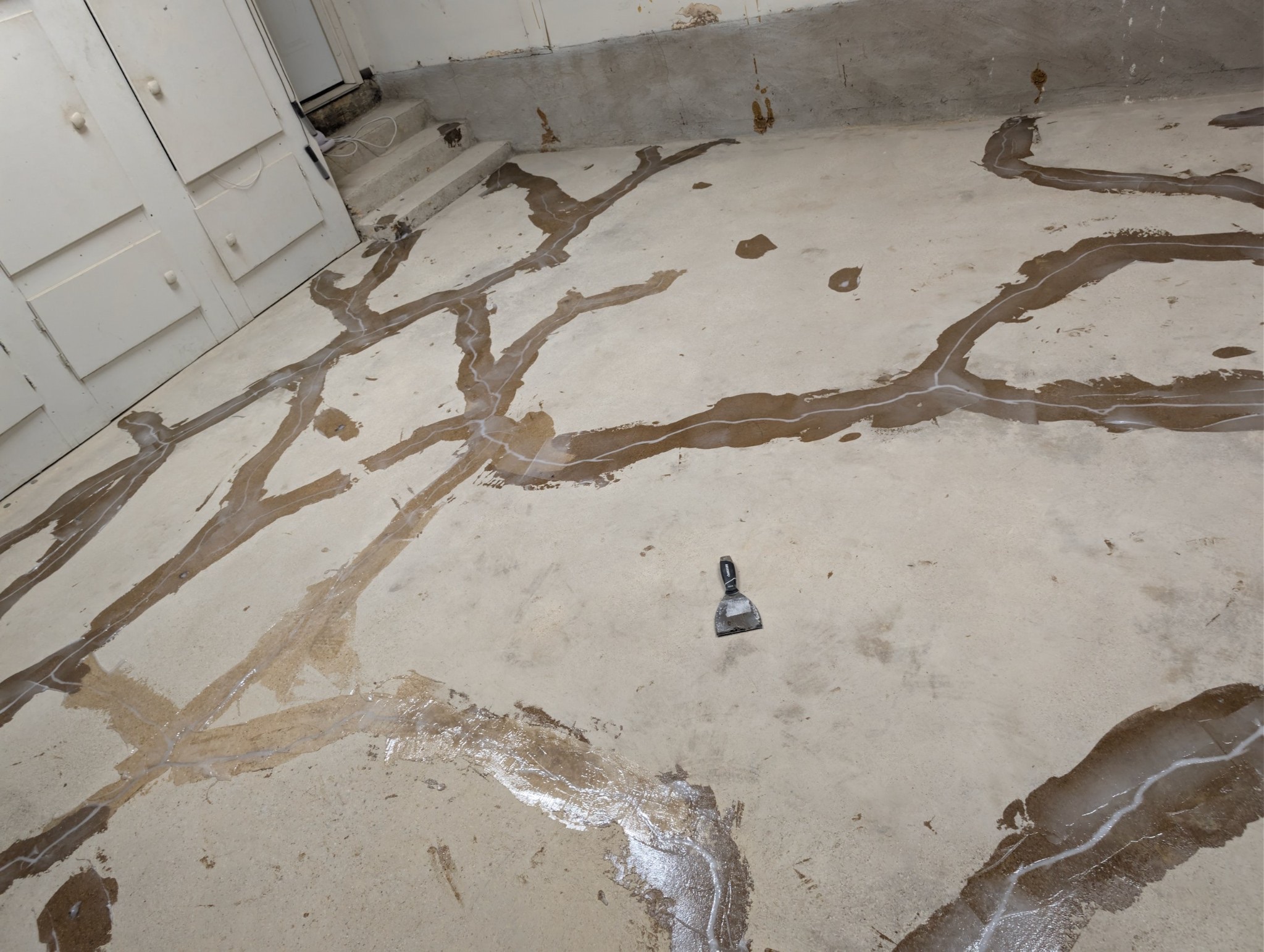
What we do instead is chase. A crack-chasing blade opens the line into a real channel, wide enough and deep enough to hold a structural amount of material, and the process follows the crack wherever it wanders rather than cutting a tidy straight line beside it. That is why a chased slab looks worse before it looks better, with dark branching lines running across the floor like the photograph above.
Then it gets vacuumed. Every time, thoroughly, because repair material bonding to dust is bonding to nothing. Only after the channel is clean and dry does anything get poured into it. That whole sequence is why we build Carrollton garage floors on ground and repaired concrete rather than coating over what is there.
Rigid Fill, Flexible Fill, and Knowing Which
A static crack gets a rigid polyurea. It goes in thin enough to find the bottom of the channel, cures harder than the slab beside it, and takes a grinder without smearing. When it comes back flush, the crack has stopped being a crack. It is now part of the concrete, and the coating carries straight over it.
A moving crack gets none of that. Filling a live crack with something rigid does not stop the movement, it just relocates the failure: the slab keeps working, the repair holds, and the concrete cracks again a half inch to one side of my nice hard patch. So those get a flexible material that stretches with the seasonal cycle instead of fighting it, plus an isolation detail so the coating above has somewhere to give.
The judgment call sits in the middle, where a crack is mostly settled but not certainly dead. When I am not sure, I treat it as moving. A flexible repair under a floor that turned out to be stable costs you nothing. A rigid repair under a floor that was still working costs you a visible line.
When a Crack Gets Treated Like a Control Joint
Sometimes the right answer is neither fill. If a crack has effectively become the slab’s relief line, the place all the seasonal movement has decided to go, then fighting it is pointless. We widen and detail it the way we would a saw-cut control joint, put a flexible joint filler in it, and carry that joint up through the finish as a deliberate line.
People push back on this, and I understand why. Nobody wants a visible line in a floor they just paid for. But a detailed joint is a straight, intentional, uniform line that reads as part of the design. The alternative is a jagged crack telegraphing up through the coating on the clay’s schedule instead of mine, and that one nobody mistakes for design.
The same thinking applies to the real control joints already cut into your slab. Those exist so the concrete cracks along a planned line, and smearing coating flat across a live one is asking for it to print through. On a flake floor the line lands in a busy chip pattern and disappears into the noise. On a mirror finish it is the first thing your eye lands on, which is worth knowing before you pick a system.
What I Will Not Coat
There is a point where crack repair stops being flooring work. When I find a crack with real vertical displacement, or a line I can follow from the slab up through the drywall, or doors in the house that have stopped latching, that slab is telling me the foundation is moving and no coating changes that.
I say so on the walkthrough and I do not take the job. Coating that floor would look excellent for a season and then split, and now the homeowner has paid twice for the same problem: once to hide it, once to fix it for real. The right order is foundation first, then let it settle, then call me.
Wet slabs are the other decline. If concrete is still driving vapor upward, that pressure gets under the coating and pushes it off no matter how well the cracks were handled, so I take a moisture reading before I commit to anything. Sometimes the answer is a vapor-tolerant primer. Sometimes the answer is wait. Either beats a floor that lets go in the second year. That honesty is the same reason we hand you a fixed-price quote after the walkthrough on your Carrollton slab rather than a number over the phone.
Questions Carrollton Homeowners Ask
Three that come up on nearly every visit.
Will the crack repair be visible in the finished floor?
On a flake system, essentially never. The chip broadcast covers the whole slab and the pattern hides everything underneath it. On a mirror-finish metallic, a wide repair can occasionally read as a faint variation once light hits it at an angle. I flag that at the walkthrough so it is your call, not a surprise.
How much does chasing add to the schedule?
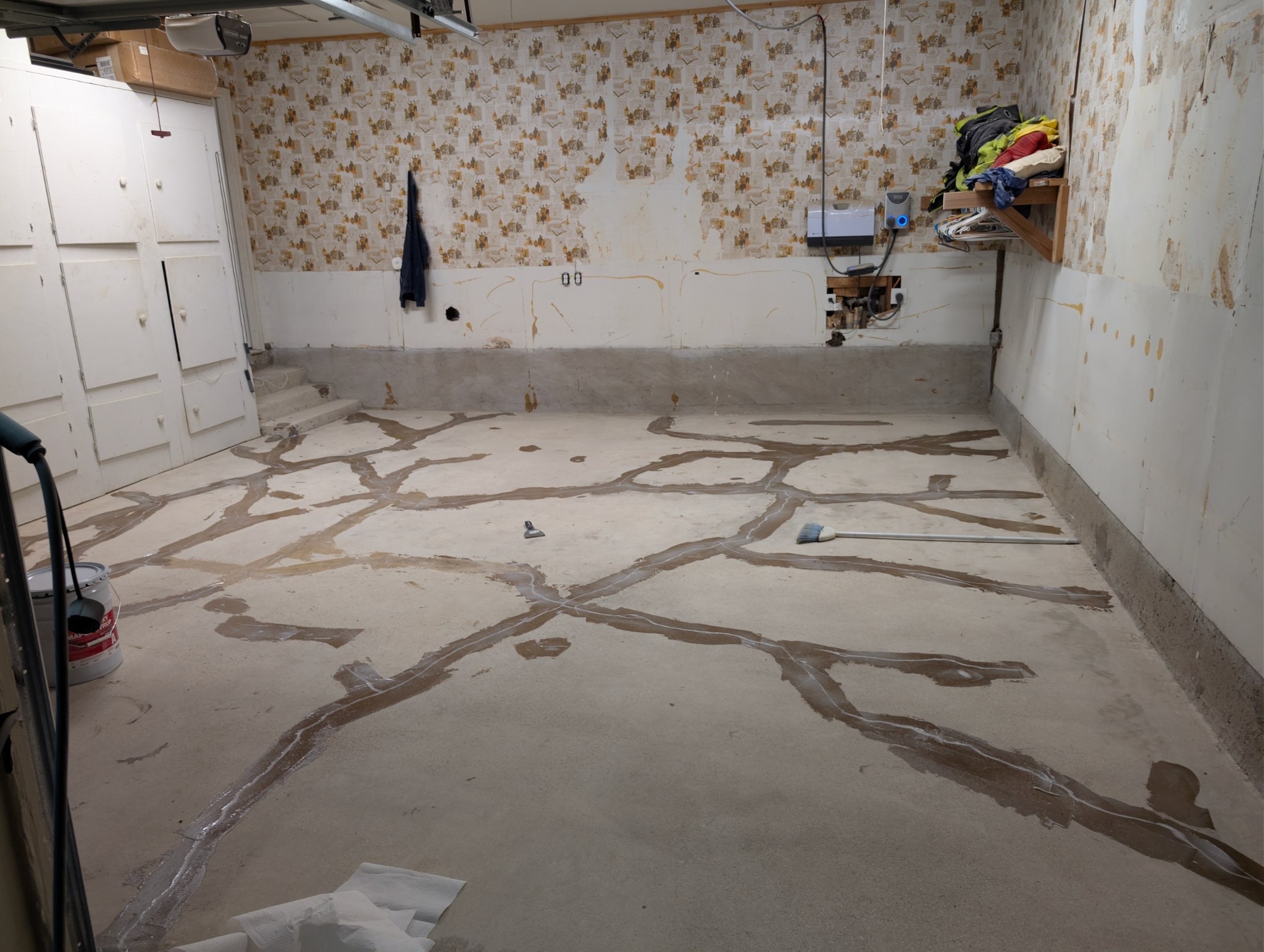
On a typical Carrollton two-car bay, crack work is a few hours inside the first day, running alongside the grinding rather than on top of it. A slab with heavy branching like the one photographed above takes longer, and I will tell you that before we start rather than partway through.
My neighbor’s coating cracked in the same spot again. Why?
Almost always a live crack that was filled rigid, or a control joint that got coated flat across. The slab kept moving, the coating had no give, and the concrete told the story right through the finish. That is the exact failure the right repair choice prevents.
Cracked Carrollton Slab? Let Me Read It
Cody walks the slab, sorts the cracks, takes a moisture reading, and prices the repair into the fixed-price quote before any resin is mixed.
Coat My Floor Get a Free Carrollton Quote: (972) 369-6302