Pick the blend on your own slab, in your own light, at the hour you actually use the room. Chip size sets how busy the floor reads and how well it swallows a repair. The clear coat, not the chip, decides whether that blend looks warm or cold at midday.
Choosing a blend is the part of my job customers enjoy and dread in equal measure. Everybody arrives with a screenshot. Somebody saw a floor online, saved the picture, and wants that exact one. Then I set the boards down on their actual concrete in their actual garage and the favorite drops to third place in about four minutes. That happens almost every time, and it is not because anyone has poor taste. It is because a chip blend is not a color you pick off a shelf. It is a pattern that behaves differently on every slab it lands on.
Why I Bring Boards to Your Slab Instead of a Showroom
A blend board is a real sample of the finished system, base coat and chip and clear, built the same way your floor gets built. What makes it useful is where I put it. On the floor, not in my hands, and not held up against a wall. You look down at a floor. That is the only angle that tells you the truth about it.
Light does the rest of the work. A Carrollton garage with the door up at ten in the morning is a completely different room than the same garage at six in the evening under one bulb over a workbench. Warm chips go muddy under cool light. Cool blends go flat under a yellow bulb. So I leave the boards there and ask people to walk out and look at them a few times through the day, with the door up and with the door down. There is no rush on this part, and the customers who take a full day deciding are never the ones who call me later unhappy.
What Small Chip Does That Large Chip Cannot
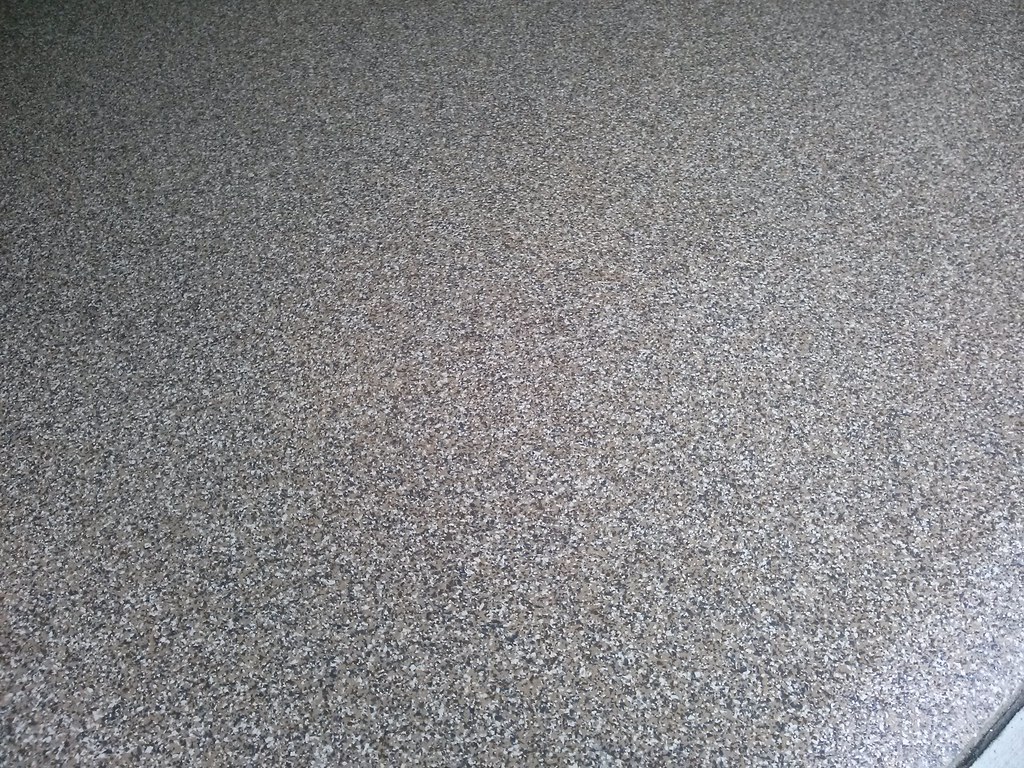
Chip size is not a style preference, it is a scale decision, and scale is about the size of the room you are standing in. Eighth-inch chip behaves like texture. From standing height your eye stops resolving individual flakes and just registers a slightly speckled surface, closer to a stone countertop than a pattern. That is why it sits so well in interior rooms, laundry spaces, and anywhere the floor should stay quiet under everything else in the room.
Quarter-inch is what goes into most Carrollton garages. At six feet up your eye picks out flakes individually, which is what gives the floor depth and keeps a two-car bay from feeling like a slab of anything. Half-inch is the loud one. Those flakes are big enough to read as a deliberate architectural surface from across the room, which is either exactly what somebody wants or exactly what they do not.
The mistake I talk people out of most often is choosing half-inch from a photograph. Photographs are shot close, and close is where big chip looks best.
Chip Size Is Also a Repair Decision
Here is the part nobody thinks about while they are enjoying the colors. If your slab needed work, the blend you choose determines how much of that work you can still see afterward.
A routed and filled crack is a line of repair material that cures a slightly different shade and sometimes a slightly different profile than the concrete around it. Chip goes over the top, and what hides it is visual busyness. Smaller flakes in higher contrast produce more busyness per square foot, so they break the eye up faster and a repair line disappears sooner. Large flakes leave more base coat visible between them, and a straight line running under a sparse pattern is a line your eye will find eventually.
So on the older tract slabs around Old Downtown Carrollton and Indian Creek, where the concrete has spent decades moving on Houston Black clay, I steer people toward quarter-inch in a multi-color blend rather than half-inch in two tones. Both are good floors. One of them keeps a secret better than the other. I will tell you which one you are looking at while we are standing on your slab, before anything is priced.
Matching the Blend to Which Carrollton You Live In
The newer master-planned subdivisions on the Castle Hills and Hebron side of town tend to come with a certain interior palette. Cooler grays, white trim, brushed nickel, lighter cabinetry. A charcoal or white pearl leaning blend sits inside that language naturally, and if the garage connects to a finished space through a door people leave open, that continuity matters more than they expect.
The older tract homes ask for something else. Those garages usually have warmer brick, older wood, and sometimes original cabinets still on the wall. Copper and champagne blends live comfortably there, where a cold gray floor can look like it wandered in from another house. This is a starting point, not a rule. Plenty of people in a nineties house want a sharp cool gray floor precisely because it changes the room, and that is a good reason. I raise the point so it is a choice instead of an accident. You can see the whole range on our Carrollton flake epoxy page.
The Topcoat Decides How Your Color Reads at Noon
This is the thing I most want people to understand before they pick anything. The chip supplies the pattern. The clear over the top supplies the color temperature, the gloss level, and whether either of those holds.
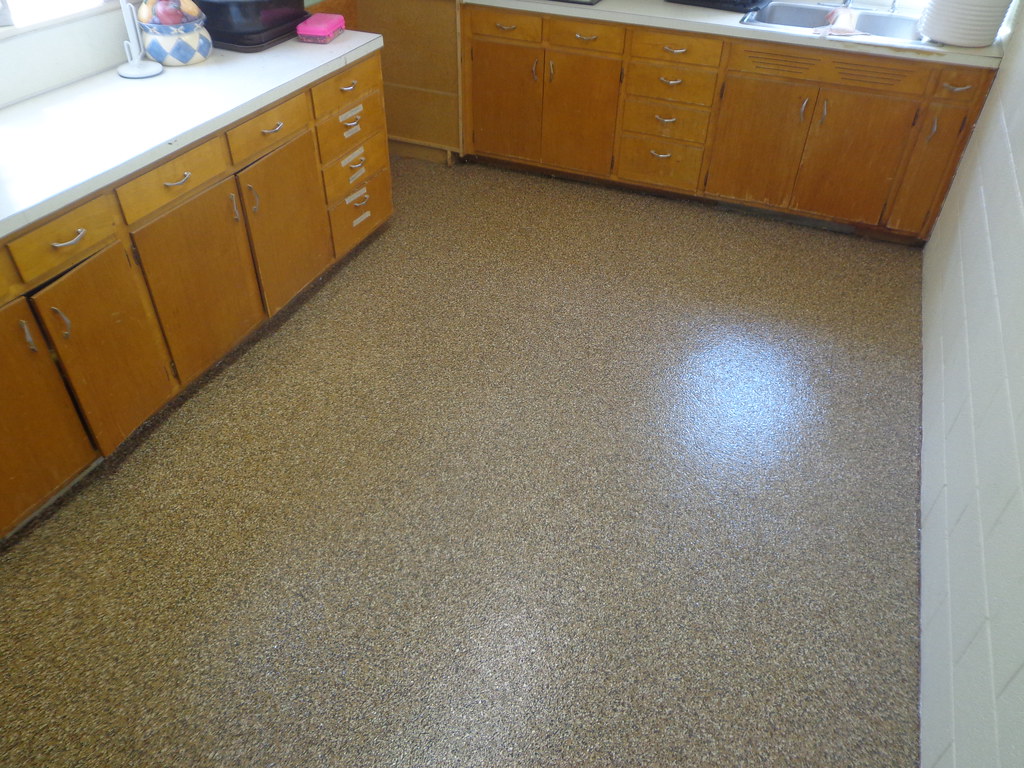
Gloss is the immediate half. A high gloss clear reflects the light source, so a blend photographs deeper and richer and reads more saturated. A satin finish scatters that reflection, which mutes the same blend a shade and hides dust and footprints far better. Same chip, two genuinely different floors. If the room takes hard midday sun through a window or an open door, gloss will throw glare back at you at exactly the hour you are in there.
The lasting half is ambering. Standard epoxy yellows under ultraviolet light, and a yellowing clear pushes every color underneath it warm. Your cool gray blend drifts toward beige over a few seasons and nobody can point to the day it happened. That is why we finish with a UV-stable polyaspartic clear on Carrollton work, so the blend you approved on the board is the blend you are still looking at in year six. Pattern is what you choose. The clear is what protects the choice. If you want a poured, flowing look instead of a chip pattern, that conversation is metallic epoxy and it goes a different direction.
Questions Carrollton Homeowners Ask
How long should I live with the blend boards before deciding?
A full day if you can spare it. Look at them in morning light with the door up, again at midday, and once more at night under whatever bulb you actually use out there. Blends that win at one hour sometimes lose at another, and you only find that out by checking more than once.
Can I mix chip sizes in one blend?
Yes, and it works well. A base of quarter-inch with some eighth-inch worked through it gives you depth without the boldness of going larger. I would rather build that on a board and let you see it than describe it, because blended sizes are hard to picture from words alone.
Will my blend look the same in the garage and inside the house?
Not exactly, and that surprises people. Interior rooms have softer, more even light, so the same blend reads calmer indoors and busier in a bright garage. If you are doing both spaces, we set boards in each one rather than deciding in the room that happens to be more convenient.
See the Blends on Your Own Floor
Boards go down in your Carrollton garage, in your light, before anything gets priced. XPS certified prep and a fixed-price quote in writing.
Coat My Floor Talk to Cody: (972) 369-6302Carrollton, TX · Finished floors · More posts · Get a Free Carrollton Quote