Epoxy makes an excellent base coat and a weaker final coat for an Irving garage. An epoxy clear ambers in sunlight and softens in summer heat. Polyaspartic stays clear and hard, which is why we put it on top of flake garage floors. Over a properly ground slab, that system can give you 15 to 20 years. Epoxy clears still make sense in some rooms that never see sun or heat.
A coated floor is a stack of layers, and people tend to talk about it as if it were one product. The part you walk on, the topcoat, is a separate decision from the base underneath, and it is the decision that most affects how the floor looks after a few Texas summers. We get asked about polyaspartic versus epoxy on almost every garage visit in Irving, often because a neighbor’s floor went yellow or peeled under the tires. Both materials have a place. This post explains what each one does well, where each one struggles, and how we pick between them room by room rather than by habit.
What a topcoat does that the base coat cannot
The base coat’s job is bonding. It soaks into ground concrete, grabs hold, and carries the flake or the color. Epoxy is very good at that. It flows well, wets out the pores of the slab and cures into a tough, well-anchored layer, which is why nearly every system we install starts with it.
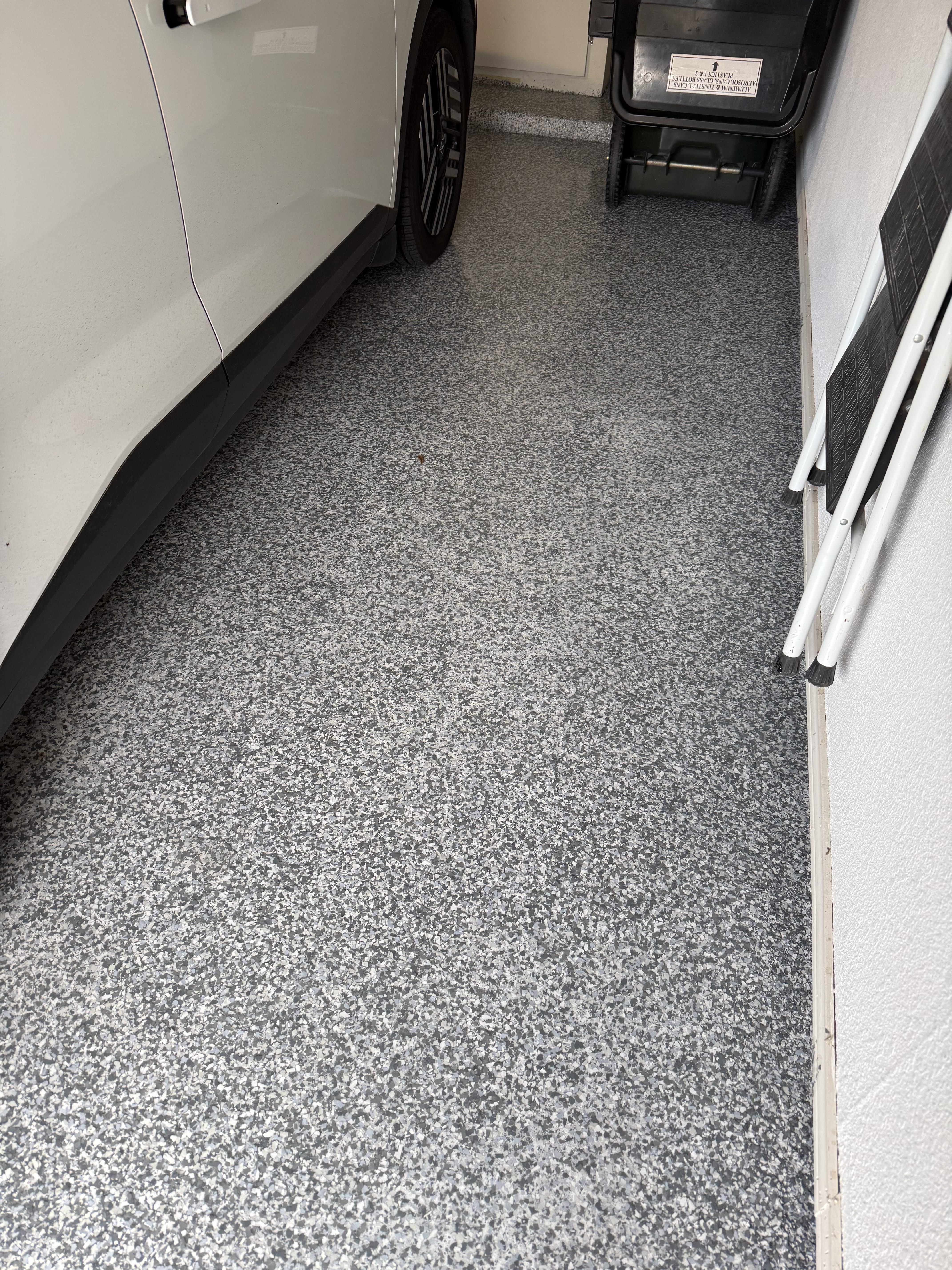
The topcoat faces a different set of problems. It takes the sunlight coming through the open door, the heat of a parked car, dropped tools, dragged bins, spilled fluids and years of mopping. It has to stay clear so the flake or pigment underneath keeps its color, and it has to stay hard at the temperatures your garage actually reaches.
So asking which is better, epoxy or polyaspartic, is a little like asking whether a primer or a finish paint is better. The more useful question is which one belongs on top in your room. In most Irving garages, the answer is polyaspartic. In a few interior spaces, an epoxy clear does the job fine. Our polyaspartic coatings page for Irving goes further into the product itself.
Sunlight through an open garage door
Epoxy has a known weakness with ultraviolet light. Over time, sun exposure turns an epoxy clear amber. It happens gradually, and it happens fastest in the strip of floor just inside the garage door where the afternoon sun lands. A gray flake floor ends up with a yellowish band across the front, and a white or light blend shows it worst of all.
Polyaspartic is light stable. It does not amber in the sun, so the color you picked on the sample board is the color you still have years later. For any garage that opens to the west or south, or where the door is up for hours while you work, that alone settles the choice.
Some people ask whether they could just keep the door closed. You could, but a garage is used with the door open, and a floor should suit how the room is used rather than the other way around. There are also windows, glass doors and reflected light from a driveway to consider. The rooms where an epoxy clear stays truly clear are the ones with almost no daylight at all.
Summer heat on the slab
A south-facing Irving garage can reach 130°F in August. Every coating gets softer as it warms, but they soften at different points. A standard epoxy clear starts to give at temperatures a closed garage reaches easily, and a soft coating is exactly what a hot tire needs to grab. That is how a floor ends up with peeled patches right where the car parks.
Polyaspartic holds its hardness much further up the temperature range. It is not magic, and it will not rescue a floor laid over a poorly prepared slab, but on a ground, well-bonded base it is the layer that keeps the surface from turning tacky under a tire.
Heat changes the install as well as the finished floor. In an Irving August the slab itself can run far warmer than the air in the garage, and a hot slab shortens every coating’s working time. So we read slab temperature and humidity before each coat, and a coat goes down only when those readings sit inside the product’s range, which in high summer often means the earlier part of the day.
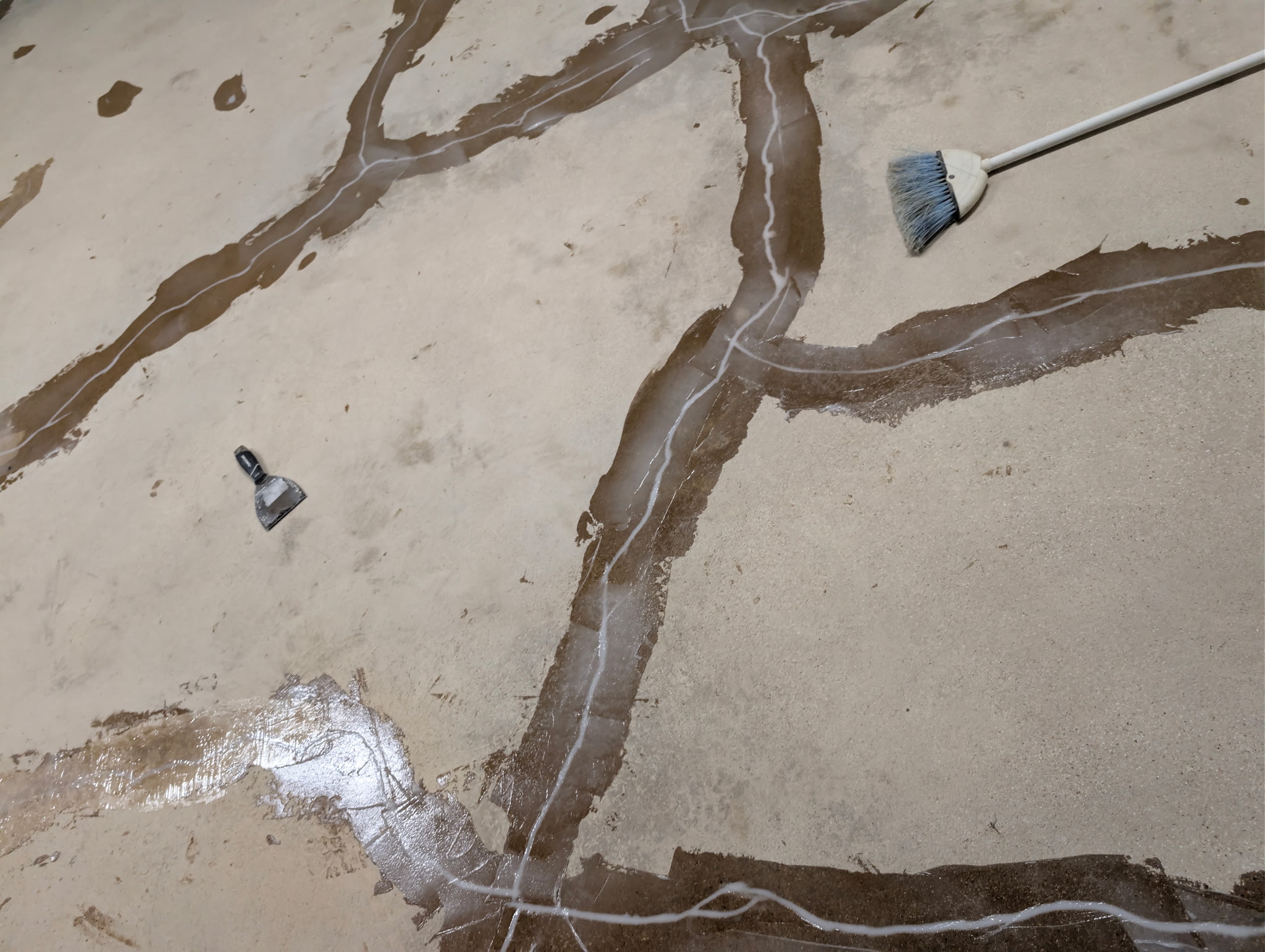
Before any of that, with Irving clay keeping slabs shifting, we chase cracks open and repair them, because no topcoat can hold across a crack that was simply painted over. The garage floor coatings we install in Irving all follow that order.
Fast cure helps, and it demands experience
Polyaspartic cures much faster than epoxy. For a homeowner, that means the garage is back in use sooner. For a business, it means less time closed. That speed is a real advantage, and it is one of the reasons the material has become the standard final coat for garage systems.
The same speed is also the hard part. Polyaspartic gives an installer a short working window once it is mixed. It has to be spread evenly and kept moving, and the batch size has to match how much floor the crew can cover before it starts to set. Humidity and temperature change that window from one day to the next, so we log conditions before each coat. A crew in a hurry, or one learning on your floor, leaves lap marks and thin spots that never go away.
This is where patience matters more than speed. On a two-car garage we mix polyaspartic in batches sized to a section we can finish cleanly, cut in the edges and the step into the house first, and roll the open floor last so no edge sits setting up while the middle is still wet. When a humid day pushes the readings out of range, we would rather move a coat to the next day than lay it into bad conditions.
Where an epoxy clear still makes sense
We do not put polyaspartic on everything by reflex. In a basement room with no windows, a shower floor, or an interior space that never sees direct sun or summer heat, an epoxy clear can be a reasonable finish. It builds a thicker film in one coat and levels out beautifully, which suits some decorative work.
The trade is that it still scratches more easily and will amber if light reaches it later, say after a remodel adds a window. We talk that through before choosing, rather than picking the cheaper material and hoping the room never changes.
Flake systems in garages are a different story. Between the sunlight, the heat and the tires, the case for polyaspartic on top is strong enough that we treat it as the default. The system underneath stays the same: a ground slab, an epoxy base with a full broadcast of chips, and a polyaspartic clear with grit added for grip. Our flake epoxy page for Irving shows the blends that system is built around.
Topcoat questions from Irving homeowners
Can you put polyaspartic over the epoxy floor I already have?
Sometimes. If the existing floor is well bonded and only tired on the surface, we can grind it, confirm the bond and add a polyaspartic clear. If it is peeling, yellowed through, or lifting under the tires, the old coating has to come off first. We test before recommending either route.
Is a polyaspartic topcoat slippery when it gets wet?
A smooth clear of any kind gets slick with water on it. We broadcast a fine grit into the polyaspartic on garage floors, which gives shoes something to grip without making the floor hard to clean. How much grit goes in depends on how often that floor sees water.
How long will a flake garage floor with a polyaspartic topcoat last?
Laid over a diamond-ground slab with cracks repaired and moisture tested, a flake system finished in polyaspartic can give you 15 to 20 years in a home garage. The topcoat may be refreshed along the way if it gets dull from heavy use, which is much simpler than replacing the floor.
If you are not sure which topcoat your room calls for, call and tell us which way the garage faces and how you use it. Cody will walk it and put the recommendation in a written quote. Finished floors are in our gallery, and the contact page reaches us any time.
The Right Coat on Top of Your Floor
Grinding, crack repair and moisture testing come before any topcoat choice, done by an XPS certified installer.
Meet Cody at Your Slab (972) 369-6302Irving coatings, all in one place · Keep reading on the blog · Contact us