A metallic floor’s color comes from two layers working together: the base coat underneath and the pearlescent pigment moving in the clear resin on top. Dark bases give the most depth, lighter bases feel softer and brighter. Pick the pairing on a sample board set down in your own room, under your own lights, because the same combination can look very different in a garage and a basement.
The first thing people do when they think about a metallic floor is scroll through pictures, and the pictures are usually lit like a car commercial. Then the floor goes into a garage with two shop lights, or a basement with no windows, and it reads differently than the photo did. Choosing color for a metallic floor is less about finding a favorite and more about understanding what each layer does and how your light will treat it. We pour these across Irving, especially in the showcase garages and finished basements around Las Colinas, and most of the color conversation happens standing in the room with boards on the floor. Here is how we think it through.
The base coat decides more than the pigment does
A metallic floor is built in layers. First comes a solid base coat, then a clear resin carrying fine pearlescent pigment, which is poured and worked while wet. The pigment is where the drama is, but the base sets the mood. Wherever the pigment thins out as it drifts, the base shows through, and those darker gaps are what make the floor look deep instead of flat.
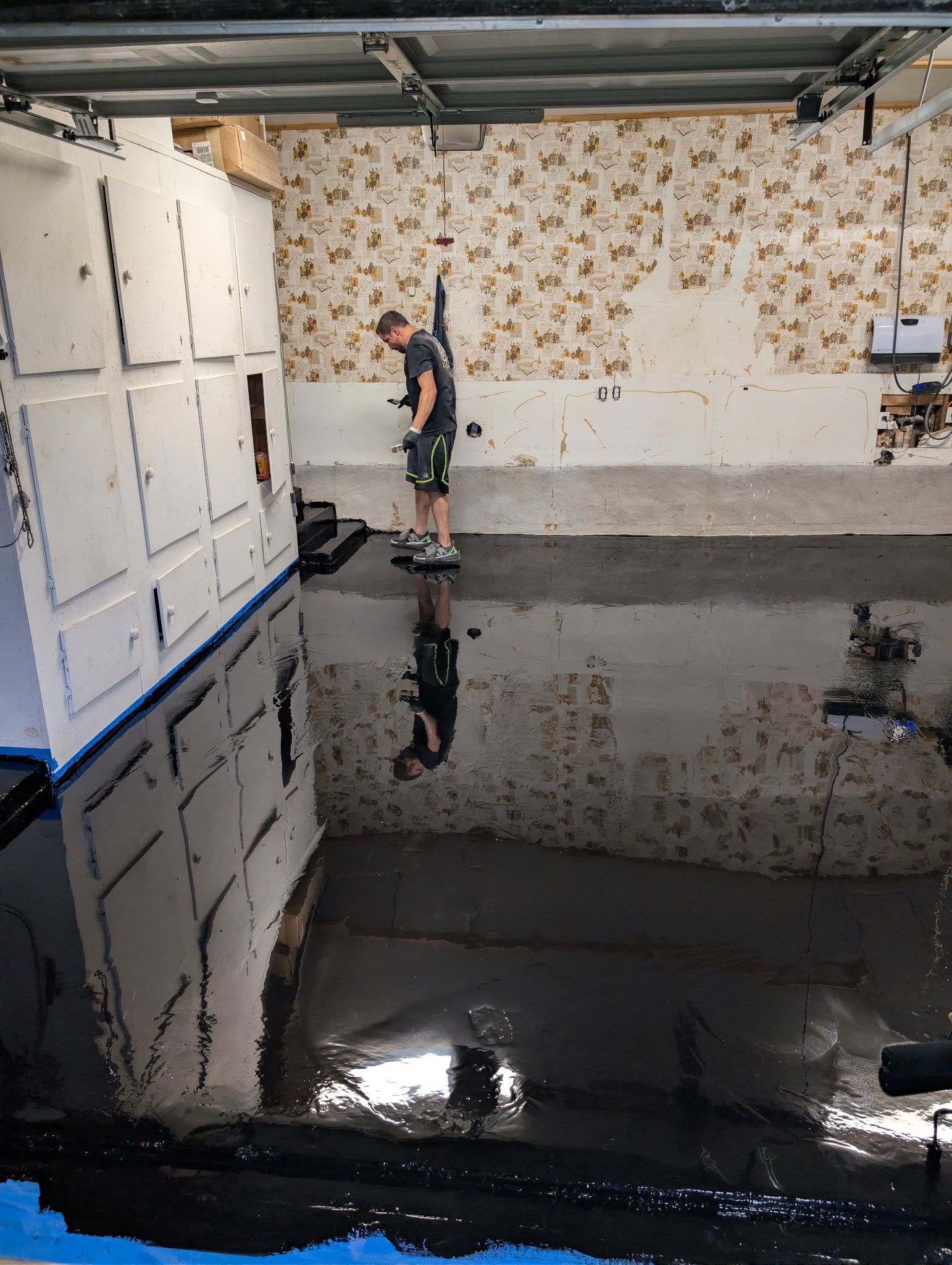
A black or charcoal base behind a light pigment gives the strongest contrast and the most three-dimensional result. It is the choice for people who want the floor to be the first thing anyone mentions. A gray base is more forgiving. The movement is still there, but softer, and dust and small scuffs show less. A light base under a light pigment gives a pale, cloudy look that can brighten a room without windows, though you give up most of the depth.
When a pairing looks wrong on a sample board, the base is usually the thing to change first. Swapping the pigment on the same base often just gives you a different version of the same problem.
Pairings that sit quietly in a finished room
Not every metallic floor needs to shout. In a finished basement, a home office over the garage, or a bar area where the furniture and the art are the focus, a calmer combination tends to age better. Champagne over a mid gray is a good example. It reads warm and a little luminous, and it sits comfortably next to wood cabinets and cream walls.
White pearl over light gray is cooler and brighter. It pulls light around a room that has only one or two fixtures, which is common in basement spaces. It also shows fewer marks than a dark floor, a practical point anyone with a dog will appreciate.
Charcoal on charcoal, with a lighter silver pigment worked thinly through it, is the quiet choice for a modern room. From the doorway it looks like a dark stone. Get closer and the movement appears. People who worry that metallic is too loud are often happy with this one, because it only reveals itself when the light hits it at an angle.
These calmer pairings are also the easiest to live with over time, since a trend color from one year can feel dated a few years later. See our metallic epoxy page for Irving for finished examples.
Pairings built to be noticed
A showcase garage is a different brief. When the room exists to display a car, a motorcycle collection or a workshop somebody is proud of, the floor can carry more color. Copper over black is the classic here. The copper flows in warm bands, the black gaps give it depth, and it looks good with polished metal parked on top of it.
Deep blue with white pearl drifting through it has the feel of water, which is why people ask for it in rooms near a pool or in a game room. Emerald over black is rarer and bolder, and in the right room it looks rich instead of loud.

Two-pigment combinations are where Cody’s background shows. He spent ten years pouring live-edge resin tables before he started on floors, and moving two colors against each other in wet resin without turning them muddy is the same skill, just on a bigger surface. We work the pigments live with brushes, solvents and air, which is why a floor like the pink and teal one above ends up with clean edges between the colors instead of a blend.
A bold floor asks more of the room around it. Plain walls and simple storage let it be the feature.
How garage light and window light change the color
The same pigment can look like two different products depending on the light. Cool LED shop lights, which are in most Irving garages, make silvers and blues crisp and can flatten warmer colors like copper and champagne a little. Warm bulbs do the opposite. Daylight through an open garage door at four in the afternoon brightens everything and exaggerates the movement.
Basements and interior rooms have the least light, and a very dark metallic can swallow what little there is. That does not rule dark floors out, but it usually means adding light or choosing a pigment with more reflection.
Angle matters too. Metallic floors shift as you walk across them, because the pigment reflects differently depending on where you stand. A pairing that looks subtle from the doorway may flash when you look down the length of the room. That is part of the appeal, and it is also why a single photo of a floor never tells the whole story.
The clear topcoat protects the color. Metallic floors are sealed under a clear coat chosen to resist yellowing, so the pigment you pick is the pigment you keep. Garages that take afternoon sun also benefit from the topcoats we cover on our polyaspartic coatings page.
Choosing from a sample board instead of a phone screen
Screens lie about metallic color. Brightness, the camera’s white balance and the photo’s lighting all push the result somewhere else. So every metallic job starts with sample boards brought to the site visit. Champagne, charcoal, copper, deep blue, emerald and white pearl are the usual starting points, and we set a few of them down in the room itself.
Look at the boards at the time of day you use the space most. Put one next to your cabinets or wherever your car sits. Walk past it. If a board looks great from one side and wrong from the other, that is useful information, since the full floor will do the same.
Keep in mind that a board is a guide, not a copy. A floor is poured at a much larger scale, and the pigment will move in its own way. The color family, the depth and the contrast will match. The exact pattern never repeats, and that is the point of the finish.
If you are planning a garage and are not sure metallic is right, our garage floor coatings page covers the flake side of the choice as well.
Questions about metallic colors
Will my finished floor look exactly like the sample board?
It will match the colors, the depth and the overall feel. The pattern will be its own, because pigment moves differently across a full room than across a small board. That one-of-one quality is what people are paying for, so we make sure you are comfortable with it before we pour.
Does a dark metallic floor show dust and footprints more than a light one?
Yes. Black and charcoal bases show dust, pet hair and dried water spots faster than gray or light bases. A dust mop handles it easily, but if the room gets heavy traffic from outside, a mid-tone base with a lighter pigment is the lower-maintenance choice.
Can a metallic floor go over an existing coated garage floor?
Only after we check the old coating’s bond. If it is loose or peeling, it comes off and we grind to bare concrete first. If it is well bonded, we can sometimes prepare the surface and pour over it. We tell you which situation you have after testing the floor in person.
If you have a color idea in mind, or just a room you want to change, call and tell us about the space and the light. Cody will bring boards and set them down where the floor will live. Our gallery shows finished floors, and the contact page reaches us directly.
See the Colors in Your Own Light
XPS certified prep, ten years of live-edge resin work, and a written workmanship warranty on every metallic floor.
Meet Cody at Your Slab (972) 369-6302See the Irving service list · More from the shop · Contact us