Flake suits the garage that works: daily drivers, tools, kids, dogs, storage. Metallic suits the space meant to be looked at, like a showcase garage, a basement bar or a finished workshop. Laid over the same ground slab and finished with a polyaspartic clear, both can give you 15 to 20 years in a home garage. The real question is what the room is for.
When people in Irving ask us to compare these two, they usually have a picture of each saved on their phone and a feeling that one is the practical choice and the other is the fun one. That is close, but it skips the parts that decide whether you are happy in year eight. How each floor hides wear, how it looks under the light your room actually has, and what kind of traffic crosses it all matter more than the photo. Below is how we walk a homeowner through the choice when we are standing in their garage, including the option a lot of people do not know they have, which is using both.
What you are looking at on each floor
A flake floor starts with a pigmented base coat. While that coat is wet, we broadcast vinyl chips across it until the base is covered, scrape off the loose chips once it cures, and lock the rest under a clear topcoat. From standing height it reads like speckled stone. Up close you see hundreds of small, flat, irregular pieces in two or three colors layered over each other.

A metallic floor has no chips at all. Fine pearlescent pigment is mixed into a clear resin, poured, and then worked while it is still liquid. The pigment drifts and pools as it settles, which leaves bands of lighter and darker color with a sense of depth, a little like looking into moving water. No two metallic floors look alike, and that includes two floors poured by the same hands in the same week.
How each one wears after a few Irving summers
Every floor picks up marks. The difference is whether you can see them. On flake, the busy pattern breaks up reflected light, so a light scratch from a bike pedal or a dragged toolbox disappears into the texture. You would have to kneel down and look for it. That forgiveness is the main reason flake is the default for garages that get used hard.
Metallic is smoother and more reflective, so a scratch cuts across the glow and catches the eye. Grit tracked in on shoes acts like sandpaper on a glossy surface over time. None of that means metallic is weak. Over a properly ground slab it is the same resin bond, and it holds just as long. It simply shows its history more honestly.
Heat is a shared concern. By late summer a closed Irving garage holds heat well into the evening, and a tire that just came off the highway is hot enough to soften a cheap clear coat. That is why both systems get a polyaspartic topcoat from us, since it stays hard at temperatures where an ordinary epoxy clear gives way.
Which spaces lean flake and which lean metallic
The housing around Irving splits along some useful lines. In Las Colinas we see a lot of finished basements and showcase garages, the kind of room where a car or a motorcycle is parked for display and the space doubles as a place to hang out. Those rooms are where metallic makes the most sense. Foot traffic is light, nobody is changing oil on the floor, and the finish becomes part of the design.
In older parts of town, around Irving Heights and Plymouth Park, garages tend to be working rooms. There is a freezer, a lawn mower, a workbench and a car that gets parked every night. A flake floor fits that life better. It shrugs off the mower wheels and hides the dirt between cleanings. Those older slabs usually need more prep as well, which is true for either system.
Valley Ranch sits somewhere in between, and so do plenty of households. The honest answer is to look at the room rather than the neighborhood. If you are more likely to sweep the floor than to show it off, lean flake. Our flake epoxy page for Irving covers chip blends in more depth.
Living with each one day to day
Cleaning is the same for both. Sweep or run a dust mop, and wash with a soft mop and a mild cleaner when it needs it. Neither floor ever needs wax or stripping. Oil, antifreeze and road grime wipe up from a polyaspartic topcoat without staining if you get to them within a reasonable time.
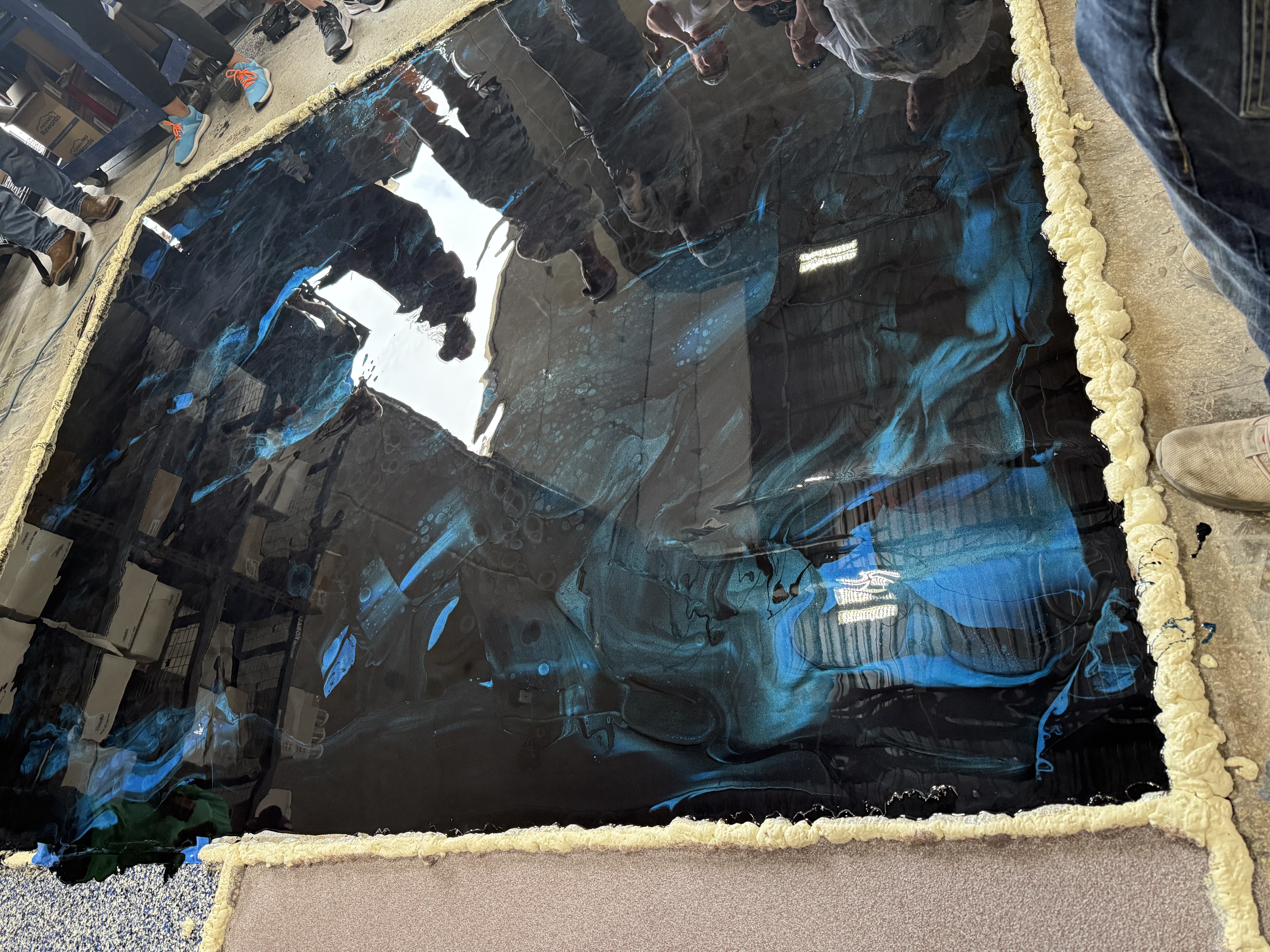
The habits are different, though. On a metallic floor, a walk-off mat at the door that leads in from the driveway pays for itself, because it stops the grit that dulls a glossy surface. Felt pads under stools and a mat under a rolling toolbox help too. On flake you can be more relaxed. Dust shows up less on a speckled floor than on a dark metallic, which some people find surprisingly noticeable.
Both floors are slick when wet without help. We add a fine grit to the topcoat on either system in areas that see water, and on a garage floor that means most of it. See our metallic epoxy work in Irving for how grit is handled on a decorative pour.
Splitting one garage between both systems
Plenty of homeowners do not have to choose. A three-car garage can carry flake in the two bays that see daily parking and metallic in the third bay, where a project car or a home gym lives. A finished workshop off the garage can go metallic while the main floor stays practical. The two systems meet cleanly at a control joint or a threshold, so the line looks planned.
The prep for a split floor is the same across the whole slab: grinding, moisture testing and crack repair, since Irving clay keeps slabs moving. Where the two systems meet takes more thought. We look for an existing control joint near the line you have in mind, because a joint is already a straight, deliberate break in the concrete, and ending one coating there makes the change look intentional. If the joint sits in the wrong spot for how you use the room, we talk through a threshold strip or a cut line instead. In older garages the joints are often chipped or packed with old patching, and those get cleaned out and rebuilt before either coating goes near them.
Scheduling takes a little more planning because metallic work goes slower than a flake broadcast and needs its own time to settle. That is fine. We would rather tell you up front that a split floor needs more days than squeeze it into a short window.
Questions Irving homeowners ask about flake and metallic
Is one of these floors more slippery than the other?
Both are glossy and both get slick with water on them if nothing is added. We broadcast a fine grit into the topcoat on either system wherever the floor sees water or tracked-in rain. Metallic takes grit a little more visibly, so we talk about placement before the final coat goes down.
Does a metallic floor take longer to install than flake?
Yes, as a rule. The pigment work is slower and needs its own settling time before the clear goes on. Neither system is a rush job for us, because the grinding, crack repair and moisture testing come first on both, and those steps are where a floor’s life is decided.
Can I see both finishes in my own garage before I decide?
Yes. We bring sample boards for flake blends and metallic colors to the site visit and set them down in your space. Garage light, basement light and a sunny doorway all change how a finish reads, so seeing them where they will live is the best way to choose.
If you are torn between the two, start with finished floors in our gallery, then call or use the contact page to describe how the space gets used. The room usually settles the question once someone is standing in it, which is why Cody brings flake blends and metallic sample boards to your slab and sets both down right where the floor will live.
Flake, Metallic or Both in One Garage
(972) 369-6302 reaches Cody directly. He is XPS certified and will tell you which system your garage is suited for.
Meet Cody at Your Slab (972) 369-6302Irving floor systems, side by side · Back to the blog · Contact us