
Commercial epoxy in Irving is priced per square foot depending on space type and system. Restaurants need NSF/FDA-compliant coatings with cove base. Retail and showrooms need a finish that photographs well and holds up to daily foot traffic. We schedule around your operating hours, so most Irving commercial jobs run Friday evening through Sunday with full return to service by Monday open.
Restaurant Kitchens: The Compliance-First Floor
Restaurant kitchen floors in Irving operate under Dallas County health code requirements that specify slip resistance, seamless surfaces, and cleanability standards. A poured epoxy floor with integral cove base (the curved floor-to-wall transition that eliminates the right-angle joint where bacteria accumulate) satisfies all of these requirements and holds up to the daily chemical exposure that strip-and-wax commercial tile does not.

The spec for a commercial kitchen floor: 100% solids epoxy base at minimum 20 mils, NSF/FDA-compliant chemistry throughout, aluminum-oxide grit broadcast into the topcoat for measured slip resistance, and cove base run 4 inches up the wall at every perimeter. It is priced per square foot depending on slab condition, cove linear footage, and drain detail complexity. Irving and Dallas County permits are pulled as part of the job, so this isn’t something you handle separately.
Retail and Front-of-House: Durability That Doesn’t Read as Utilitarian
The front-of-house in a restaurant or the main floor of a retail store has different requirements from a kitchen: the finish needs to hold up to thousands of square feet of daily foot traffic while looking intentional rather than industrial. A full-broadcast flake system with polyaspartic topcoat handles both. The flake pattern gives the floor depth and visual interest; the polyaspartic is UV-stable, scuff-resistant, and easy to maintain with standard commercial cleaning equipment.
Color selection matters in retail. Floors that are too dark absorb light and make smaller spaces feel enclosed. Floors that are too light show scuffs and spills under retail lighting. The sweet spot for most Irving retail is a medium-value neutral with enough chip variation to hide the everyday wear that accumulates regardless. We’ve done enough Las Colinas and Heritage District retail buildouts to know what holds up and what photographs well on opening day.
Showrooms: The Floor as a Feature
Auto dealerships, jewelry showrooms, and appliance showrooms in the Irving and Las Colinas corridor use metallic epoxy for a specific reason: the floor is visible from outside the building and it signals the quality tier of what’s inside before anyone opens the door. A pearl or silver metallic system on a dark base creates depth that flat tile and polished concrete don’t produce. The floor reads as premium without being loud.
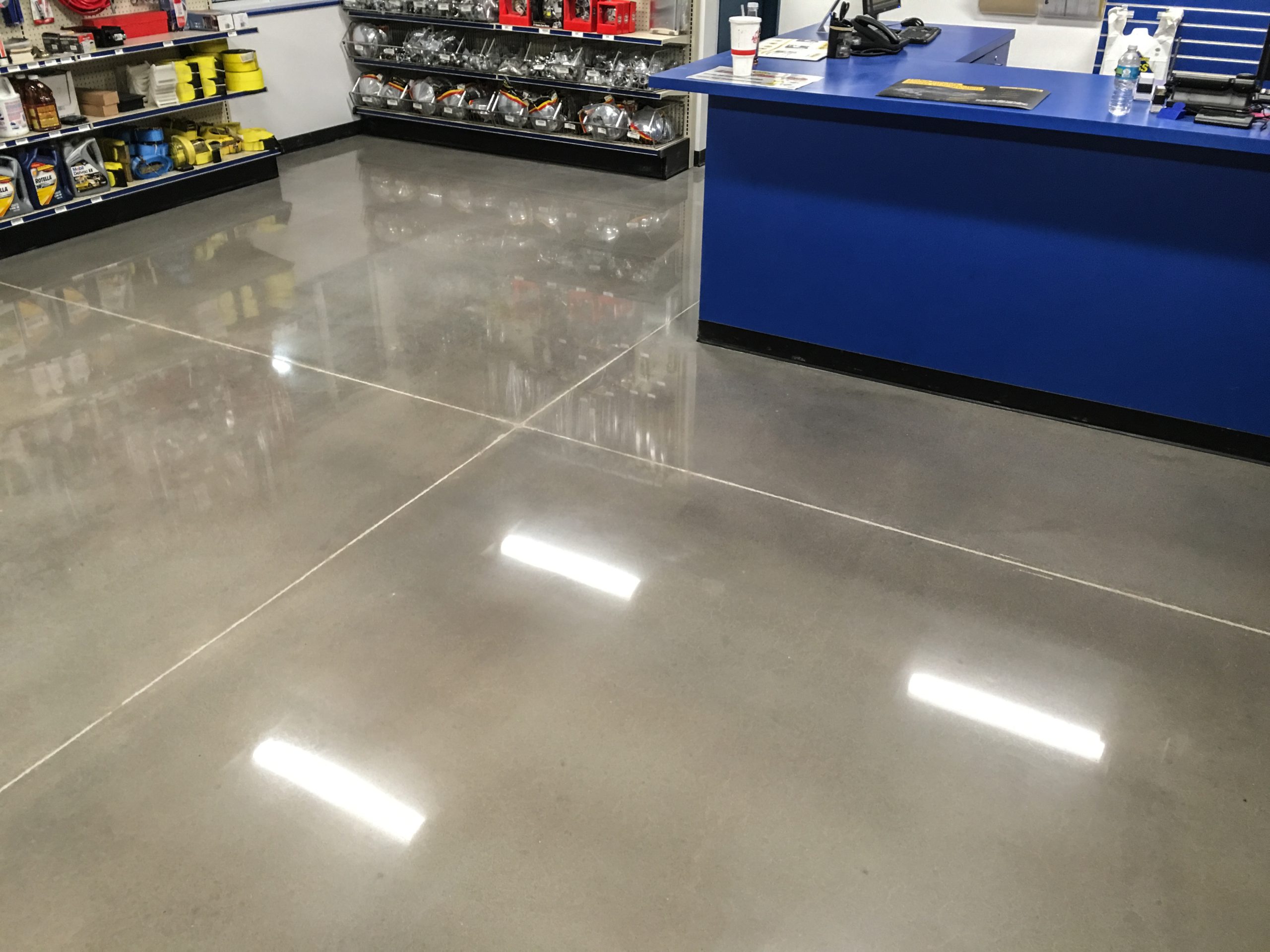
Showroom metallic is priced per square foot for a standard two-coat system with polyaspartic topcoat, above the flake tier. The higher cost is the metallic pigment itself (more expensive than vinyl chip), slower application (the pigment movement requires more time per square foot), and the skill involved in producing consistent, intentional results at showroom scale.
Gyms and Light Industrial: Spec by Use
Gym floors in Irving need impact absorption and surface hardness simultaneously, a combination standard epoxy doesn’t deliver well. The solution is a higher-mil system (50-80 mil total) that provides enough thickness to absorb dropped weight plates without transmitting the shock fully to the slab. For CrossFit-style boxes and fitness studios that use rubber flooring in the lifting zones, the epoxy handles perimeter areas, locker rooms, and transition spaces where rubber would be excessive and impractical to clean.
Light industrial in the Las Colinas and DFW industrial park corridors typically needs 80-120 mil systems with documented abrasion ratings and chemical resistance. The spec depends entirely on what’s happening on the floor: forklift traffic requires different hardness than light assembly, which requires different chemistry than food-adjacent warehouse use. We size the system to the actual use case, not the highest spec that can be sold.
Scheduling and Property Manager Documentation
Commercial projects in Irving typically run on weekend schedules to avoid business disruption. The standard workflow: final walkthrough Friday afternoon, application begins Friday evening, return-to-foot-traffic Saturday or Sunday depending on system and ambient conditions, full vehicle traffic cleared by Monday morning. For properties with Monday morning deliveries or first-shift operations, the schedule is confirmed in the proposal, not figured out on job day.
Property managers and commercial tenants require a specific documentation package: certificate of insurance (we carry full general liability coverage), signed warranty, before-and-after photos, and a copy of any Irving or Dallas County permits pulled for the work. All of this is standard on every commercial job. Single point-of-contact throughout so the property manager isn’t chasing subcontractors for paperwork.
Irving Commercial Epoxy FAQ
Can commercial work be done without closing the business?
Yes in most cases. We section the floor and work around your operating schedule. Most Irving commercial spaces under 2,500 sq ft can be handled over a weekend without a single business day of closure.
Is restaurant epoxy actually health-code compliant?
When specified correctly, yes. The chemistry must be NSF/FDA-compliant throughout, the surface must be seamless and cleanable, and the cove base must eliminate the floor-to-wall joint. We pull Irving and Dallas County permits and document compliance for your health inspection file.
What’s the lead time for Irving commercial jobs?
Typically 2-3 weeks from deposit to start. Larger jobs (5,000+ sq ft) may need 4-5 weeks for scheduling and material procurement. We don’t overbook weekends, so the schedule you’re quoted is the schedule you get.
Do you handle permits for commercial work?
Yes. Irving and Dallas County permits are pulled as part of the job for any work that requires them. Residential garage floors typically don’t require permits; commercial kitchen and industrial installations typically do.
Irving Commercial Epoxy
10+ years of epoxy work across Irving, Las Colinas, and DFW. Bonded, insured, permitted.
Discuss My Project (972) 369-6302Irving Commercial Epoxy page · More posts · Discuss my project