
A metallic epoxy floor becomes a genuine showpiece when the person applying it understands how mica pigment moves and can steer that movement with intent. In a Fort Worth home with real character, the floor can read like poured stone or river glass rather than a garage surface. Cody spent a decade in live-edge resin work, so he treats a metallic floor the way he treats a river table: as a piece, not a product.
Most epoxy floors are meant to disappear. You want a garage floor that looks clean and gets out of the way. A metallic floor is the opposite. It is meant to be looked at. When a Fort Worth homeowner tells me they want metallic, they are not asking for a durable surface, or not only that. They are asking for the floor to be the thing a visitor notices when they walk into the space. That changes everything about how the job is approached, and it is why metallic is the one service where the applicator matters more than the material.
Metallic epoxy gets its look from mica pigment powder suspended in a high-build epoxy resin. When it is worked with a squeegee and a blower, the metallic particles move, separate, and layer across the surface. That movement is the design. No two areas of the floor develop identical depth or shimmer, because the pigment responds to how the tool crossed it, to the temperature, to the exact geometry of the slab. Done with intent, it reads three-dimensional and alive from almost every angle. Done without understanding, it reads muddy and busy. The gap between those two outcomes is entirely in the hands doing the work.
Why a Resin Background Changes the Result
Before Cody ever coated a floor, he spent ten years building live-edge resin tables. That is not a garnish on the resume; it is the whole reason his metallic floors come out the way they do. At the table scale, every flaw sits at eye level, six inches from a buyer’s face, with nowhere to hide. You learn to read how pigment moves, how it settles, how a channel pulls the eye, how light changes the whole piece from morning to evening. A floor is a bigger canvas, but the material logic is identical. He is not learning metallic on your floor. He is applying a decade of resin instinct to it.
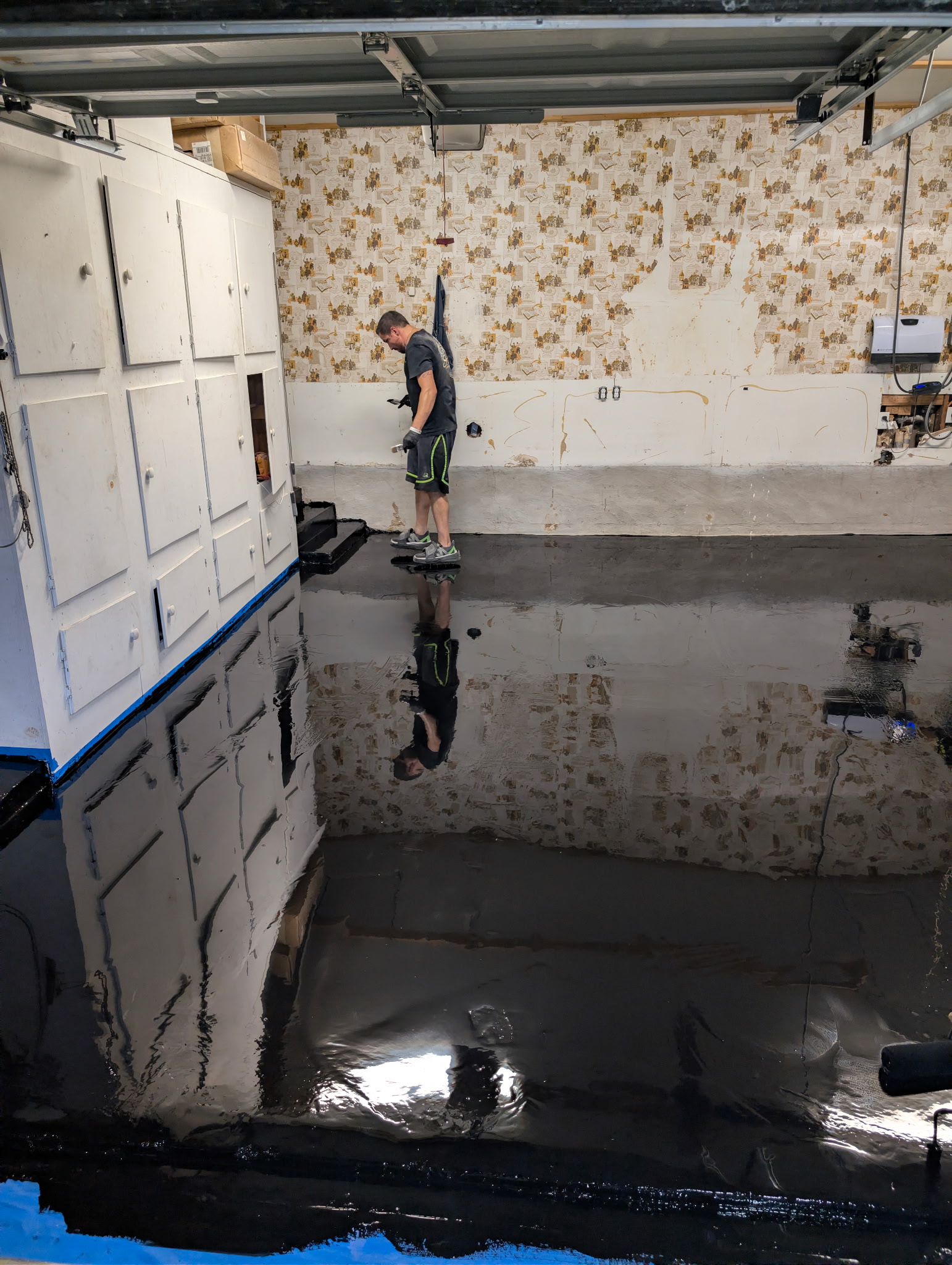
This is why I do not hand metallic work to a subcontractor and why I run every critical step myself. The pigment work is the artistry, and the artistry does not transfer to whoever is cheapest that week. A Fort Worth homeowner paying for a showpiece deserves the person whose hands actually know the material, on the floor, for the whole pour.
Color Direction for a Fort Worth Home
Fort Worth has a lot of homes with genuine character, from Stockyards-adjacent properties with a warm, storied feel to newer builds where the garage or basement connects to finished living space. The right metallic direction depends on the house. For a serious, masculine garage I often lean toward deep charcoal and pewter, which reads like brushed metal underfoot. For a living-adjacent space I steer toward warm bronze and copper that coordinate with interior finishes rather than shouting over them. For the homeowner who genuinely wants the floor to be the first thing anyone sees, blue-teal and pearl combinations turn the surface into the centerpiece.
Homeowners with older-Fort-Worth character frequently go warm and earthy to match the bones of the house, and that instinct is usually right. But there is no formula. The color conversation happens on-site, where I can see the space, the light, and the finishes it has to live alongside, and where I can talk through how each direction will actually behave once it is on your floor.
The Prep No One Sees Is Why the Look Lasts
Here is the part that never makes the photos: a showpiece metallic floor lives or dies on prep that is completely invisible once the pigment goes down. The most beautiful pour in the world fails fast if the slab underneath it was never ready. So before a drop of metallic touches the floor, I diamond-grind the concrete to open its pores for a real mechanical bond, moisture-test it because the Tarrant County clay under a Fort Worth slab can push vapor up through the concrete and blister a coating from below, and address any active cracking so a fault line does not telegraph up through an otherwise flawless surface. On a garage floor a client might forgive a small flaw. On a metallic floor that is meant to be looked at, every imperfection sits in plain view, which is exactly why the hidden work has to be perfect.
The heat on a Fort Worth slab makes that prep discipline matter even more on a metallic pour than a flake one. The pigment work happens live, in the cure window, and heat shortens that window without warning. A base coat that kicks too fast on an overheated slab gives me less time to move and layer the mica before it locks, and a rushed metallic reads muddy and busy instead of deep and alive. So I time the pour to the slab temperature, sometimes starting early in summer, precisely so I have the full working window to steer the pattern. The artistry everyone pays for is only possible when the timing and the prep beneath it are respected first.
Where Metallic Belongs in a Fort Worth Home
Not every space wants a metallic floor, and part of doing this honestly is saying so. A working garage where you actually turn wrenches is usually better served by flake, which hides wear and cleans up easy. Metallic earns its place in the rooms that connect to how the home is lived in and shown off. A finished basement that has become the family’s real living room. A home bar or media room where the floor is part of the atmosphere. A studio or she-shed conversion out on the west side. A showpiece garage that doubles as a weekend hangout, where a charcoal-and-pewter pour catches the light off an open door and turns the space into something you want people to see. Those are the rooms where the extra time and cost of metallic pay off, because the floor is doing a job that a plain surface never could.
What ties all of those together is that the client wants something no one else has. That is the honest promise of metallic and the reason it cannot be mass-produced. A Fort Worth homeowner choosing metallic is not buying a floor off a shelf; they are commissioning a one-of-a-kind piece that happens to be walkable. Understanding that up front changes the whole conversation, because the goal stops being to match a picture and becomes to build something that fits their space and belongs only to them.
How the Conversation Actually Happens
Metallic does not sell off a stack of sample chips, because a chip cannot show you movement. What I bring instead is photos from previous floors and a real conversation about characteristics: how a pattern moves, how it shifts between daylight and garage LEDs, how it reads at the doorway versus the middle of the room. A metallic floor is inherently one-of-a-kind, so the honest promise is not that yours will look exactly like a photo. It is that we will aim for a direction that fits your space, and the floor will be uniquely yours. That conversation happens at the on-site visit, standing on the actual slab, not over a phone.
Lighting is a bigger part of that conversation than most people expect, because a metallic floor is never one fixed thing. The same pour reads differently at the doorway than in the middle of the room, differently in morning daylight than under garage LEDs at night, differently in a space with a west window catching hard afternoon sun. Cool white LEDs pull the silver tones forward; warm bulbs bring out the bronze and gold. That shifting quality is part of what makes metallic feel alive rather than printed, but it also means the color direction has to account for how your specific Fort Worth space is actually lit. I would rather stand in the room with you and factor that in than have you fall for a chip under showroom light and be surprised by your own garage.
If a metallic showpiece is what you have been picturing for a Fort Worth garage, basement, or studio, the next step is that conversation. The Fort Worth metallic epoxy page covers the system and process, and the gallery shows real metallic work so you can see how the pigment actually behaves.
Fort Worth Metallic Epoxy FAQ
Can I specify exactly how my Fort Worth metallic floor will look?
Not precisely, and that is by design. The mica pigment moves during application and the result depends on temperature, humidity, tool angle, and your specific slab. Cody can steer toward a direction, lighter or darker, more veining or less, but the floor will be unique. That uniqueness is exactly what a showpiece floor is.
Does a metallic floor hold up as well as flake?
Yes, with a polyaspartic topcoat. The durability lives in the prep and base coat, which are the same across systems: diamond-ground slab, full-solids primer, and a polyaspartic topcoat. The metallic pigment changes the look, not the toughness. A properly built metallic floor takes daily use and Fort Worth heat just like flake.
Will my metallic floor look different under garage lighting at night?
Yes, noticeably. Most metallic floors shift between daylight and artificial light. Cool white LEDs emphasize silver tones, while warm LEDs pull out the yellow-gold. This is worth discussing at the on-site visit so we factor your actual Fort Worth garage lighting into the color direction.
Why does a resin background matter for a metallic floor?
Metallic is pigment artistry, and the failures almost always come from an applicator who never understood how the pigment moves. Cody spent ten years in live-edge resin work where every flaw is at eye level, so he reads and steers the pigment on instinct. That hands-on background is the whole difference on a showpiece floor.
Fort Worth Metallic Epoxy
Ten years of live-edge resin experience means Cody works metallic like a piece, not a product. See real examples at the on-site visit.
Start the Conversation (972) 369-6302Fort Worth, TX services · More posts · Start the conversation