
Alliance-corridor warehouses in far-north Fort Worth need a commercial floor built for forklift traffic, abrasion, and constant loading, not a residential system scaled up. The right build is a high-thickness, abrasion-resistant system on a properly ground slab, and the install gets phased so one zone stays operational while another is coated. The floor and the schedule both have to fit how the facility actually runs.
The Alliance corridor in far-north Fort Worth is one of the busiest logistics and light-industrial zones in North Texas, and the floors in those buildings do not get a day off. Forklifts run the aisles, pallets drag across the surface, loading docks see constant traffic, and the concrete underneath takes abuse that would destroy a residential coating in a month. When a warehouse or distribution operator calls me about a commercial floor, the conversation is completely different from a garage conversation. It starts with what the floor has to survive, and it never stops being about that.
Commercial epoxy is not residential epoxy poured on a bigger slab. High-traffic industrial surfaces need higher build thickness, tougher and more abrasion-resistant topcoats, and a return-to-service plan that works around the operation. A homeowner can lose their garage for a weekend without much cost. A distribution facility that loses a zone for a week is losing real money every hour. That reality drives every decision, from the system spec to the schedule.
Building for Forklift Traffic and Abrasion
The core requirement in an Alliance-area warehouse is durability under mechanical load. Forklift wheels concentrate weight on a small contact patch and drag it across the floor thousands of times a day, and that grinding is what wears out an underspecced coating. So the build goes thicker and tougher: a properly ground slab for a deep mechanical bond, a high-build base to carry the load, and an abrasion-resistant topcoat rated for traffic lanes rather than for looks. In wet zones and prep areas, a quartz broadcast adds anti-slip grip so the floor is safe as well as durable.
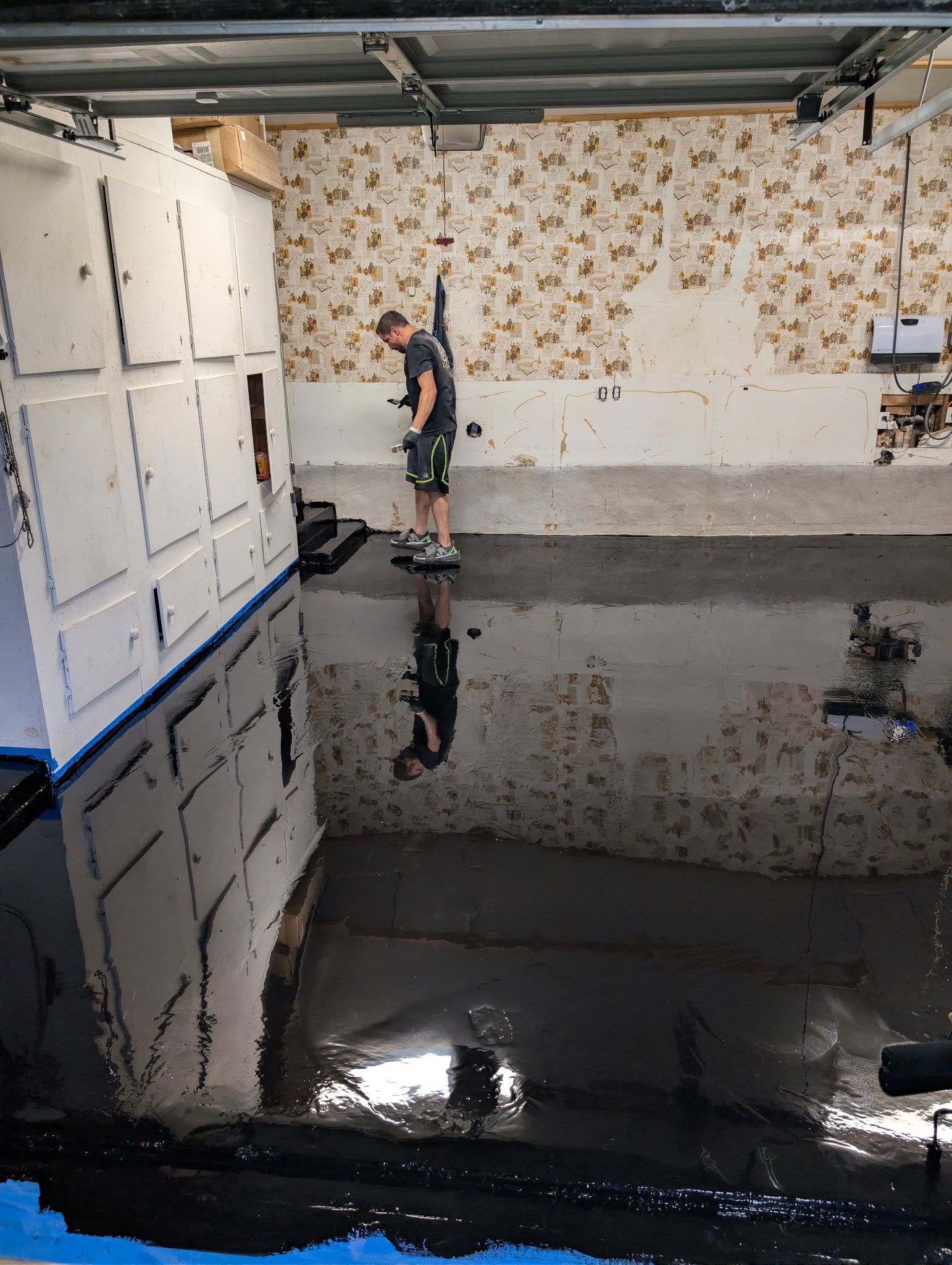
The prep matters even more in a warehouse than a garage, because there is no hiding a weak bond under industrial traffic. I grind every commercial slab to profile, address cracks and control joints, and test for moisture behavior on the Tarrant County clay these buildings sit on. An industrial floor that fails does not just look bad; it creates a safety and downtime problem. So the underlying discipline is the same craftsman patience I bring to a residential job, applied at a scale where the stakes are higher.
Phasing the Install Around the Operation
The scheduling piece is where a lot of commercial floor projects go wrong, and it is where the conversation really earns its keep. A working Alliance warehouse usually cannot shut down entirely for a floor, so the answer is phasing. We coat one bay or one zone while the rest of the facility keeps running, then rotate through the space section by section. It takes longer on the calendar than a single-shot pour, but it keeps the operation moving, and for a distribution facility that trade is almost always worth it.
For smaller commercial spaces, and for owners who can give up a weekend, we run Friday evening through Sunday so the floor reaches cure before Monday. For faster polyaspartic systems in the right conditions, evening installs with next-day return are sometimes possible. The point is that the schedule gets built around your operation, not the other way around. We walk the facility, understand your traffic patterns and downtime tolerance, and phase the work to fit.
Why the Tarrant County Slab Sets the Ceiling
Before any of the durability talk matters, the slab under an Alliance warehouse has to be understood, because it sets the ceiling on how good the finished floor can be. These buildings sit on the same expansive Tarrant County clay as the houses a few miles away, and that clay moves with the seasons. A warehouse slab is bigger and usually thicker than a garage pour, but it is not immune to the ground beneath it. Control joints open and close, hairline cracks appear along stress lines, and slab curl can lift edges near the joints. An epoxy system laid over that movement without addressing it will crack and delaminate along the exact lines the slab is already telling you about.
So the first thing I do on a commercial walk is read the slab honestly. Where are the control joints and are they moving. Is there active cracking or is it stable and cosmetic. How does the concrete behave for moisture, because a slab that wicks vapor from the clay below will blister a coating from underneath no matter how good the topcoat is. On a big floor those questions decide whether we can coat straight away, whether we need a moisture-mitigation primer first, or whether a section needs real repair before anything decorative goes down. Answering them up front is what keeps a commercial floor from becoming a warranty problem six months later.
What Downtime Actually Costs, and How Coating Beats It
The reason a well-planned commercial floor pays for itself has less to do with looks than most owners expect. An unsealed or failing warehouse slab is a slow, constant drain. Concrete dusting coats inventory and equipment and fouls the air the crew breathes. Porous concrete soaks up oil and hydraulic fluid into stains that never clean up and become slip hazards. Spalled and pitted surfaces catch pallet-jack wheels and beat up forklift tires. Every one of those is a small recurring cost that a sealed, abrasion-resistant floor simply eliminates. When I quote a commercial job, that is the frame that matters: not what the floor costs to install, but what the current floor is quietly costing every week it stays the way it is.
The same logic runs through the scheduling. A day of unplanned downtime because a floor finally failed is far more expensive than a planned, phased install that keeps the operation running. That is exactly why we build the schedule around the facility instead of the other way around. A floor that goes down on your terms, in zones, over a plan you approved, protects the operation. A floor that fails on its own terms, mid-shift, in a traffic aisle, does the opposite. Getting ahead of it is the whole point.
Matching the System to the Zone
One of the mistakes I see on commercial jobs is a single system slapped across an entire building regardless of what each zone actually does. A warehouse is not uniform. The main traffic aisles need maximum abrasion resistance. A wash-down or prep zone needs chemical resistance and anti-slip. A front office or showroom area near the dock might want a flake finish that reads more finished for visitors and staff. We spec the system to each zone rather than defaulting to one package, because the floor should match the work happening on top of it.
There is also the heat to plan around, and on a floor this size it is not a footnote. A big slab under a warehouse roof stores real warmth deep into a summer evening, and coating chemistry reads the temperature of the concrete, not the air above it. A base coat that hits an overheated Alliance slab kicks too fast to bond and work properly, and on a five-figure square-foot floor a debonded aisle is a repair measured in downtime. So in summer we time commercial pours to the slab’s thermal window, sometimes running the work early or overnight, so the base and topcoat set in the range they need. It is the same discipline I bring to a garage, scaled to a floor where a rushed cure costs far more to fix.
If you run an Alliance-corridor warehouse or any Fort Worth commercial facility and the floor is due, the honest starting point is a walkthrough. The Fort Worth commercial epoxy page covers the systems and scheduling, and the gallery shows real commercial work.
Fort Worth Commercial Epoxy FAQ
Will a commercial epoxy floor hold up to forklift traffic in an Alliance warehouse?
Yes, when it is built for it. Forklift traffic demands a high-build, abrasion-resistant system on a properly ground slab, not a residential coating scaled up. We spec the thickness and topcoat for traffic-lane load and grind the slab for a deep mechanical bond so the floor carries the wear instead of failing under it.
Can you coat our warehouse without shutting the whole operation down?
Almost always. We phase the install, coating one bay or zone while the rest of the facility keeps running, then rotate through the space. It takes longer on the calendar than a single pour, but it keeps your operation moving, which for a distribution facility is usually the whole point.
Do different areas of the warehouse need different floor systems?
Often, yes. Main traffic aisles need maximum abrasion resistance, wash-down and prep zones need chemical resistance and anti-slip grip, and office or showroom areas may want a finished flake look. We spec the system per zone rather than running one package across the whole building.
How do you handle the slab prep on a big commercial floor?
The same disciplined way as a residential job, at a larger scale. We diamond-grind to profile, address cracks and control joints, and test moisture behavior on the Tarrant County clay these buildings sit on. Under industrial traffic there is no hiding a weak bond, so the prep is where an industrial floor is won or lost.
Fort Worth Commercial Epoxy
Alliance-corridor warehouses get systems and schedules built around how the facility actually runs. Send your square footage and space type for a site evaluation.
Schedule a Site Visit (972) 369-6302Fort Worth, TX services · More posts · Schedule a site visit