Pool decks around Highland Park crack because the clay under them swells and shrinks with the seasons. A coating laid straight over those cracks will split along them. We chase every crack open, fill it with real repair material, keep the control joints working, then lay a slip-safe, heat-reflective system. Once swim season winds down is a good time to get on the schedule.
By the end of summer, most pool decks show what the year did to them. A crack that was a hairline in spring has opened up. A section near the coping has dropped a little. The surface is hot enough at midday that nobody walks across it barefoot. In Highland Park, those cracks are rarely a sign that the deck was poured badly. They come from the ground. This post explains why decks here move, how we deal with the cracks before coating, and why the weeks after the pool closes are often the best time to do the work.
Why decks here crack in the first place
Highland Park sits on Houston Black clay. When it rains, that clay takes on water and swells. When it dries out in a long Texas summer, it shrinks back. A concrete deck resting on top of it gets pushed up and let down, over and over, year after year.
A pool deck has it worse than a garage floor. It is outdoors, so it takes every rain and every dry spell straight on. Pool water splashes over the edge and soaks into the ground near the coping, while the far side of the deck may stay dry. One part of the slab swells while another stays put, and the concrete cracks at the weak points between them.
That movement does not stop because a coating goes on. So the job is to build a system that lives with it, flexing a little each season and holding its bond while the ground underneath shifts. Our epoxy pool decks page for Highland Park goes through the system we use.
Chasing cracks and leaving control joints alone
A coating rolled over a crack becomes part of that crack. The first time the clay moves, the coating splits along the same line, usually within a season. That is the most common failure we see on decks somebody else coated.
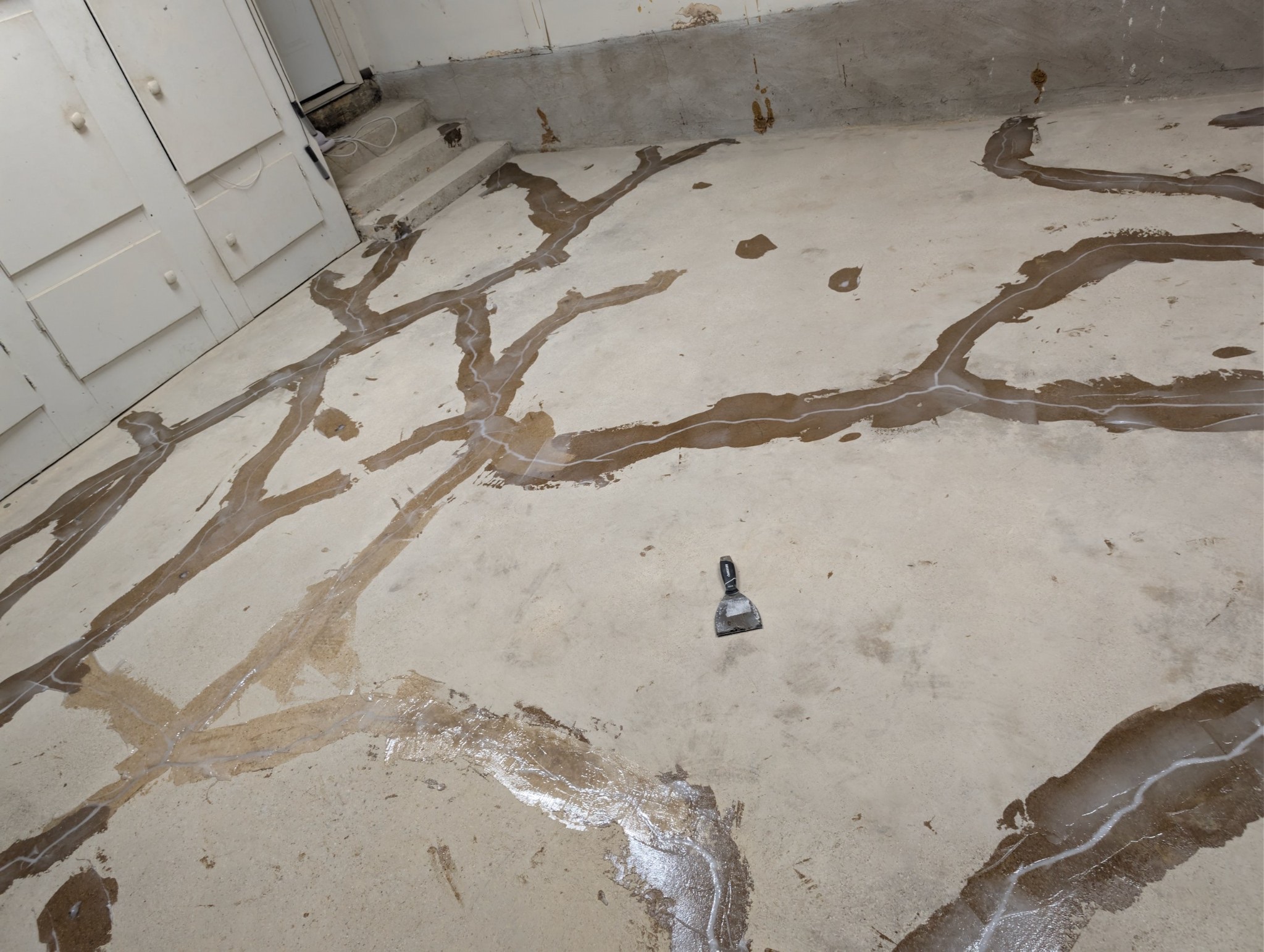
We chase each crack mechanically, opening it so the repair material has something to grab, then fill it and grind it level. On cracks that keep opening, a crack-isolation membrane goes down first and lets the coating flex above them.
On a big deck this takes time. A web of cracks across the whole surface can mean long hours of routing and filling before anything else happens, and we would rather spend those hours than lay a pretty coat that splits by the next summer.
Control joints are a separate matter. Those are the straight cuts placed in the deck on purpose so the concrete cracks there instead of at random. They are meant to move. If a coating bridges them blind, the joint keeps moving and the coating cracks right above it. We keep control joints working through the coating, so the deck can still do what its builder planned. Our epoxy pool decks service page shows how that fits into the full system.
Coping, drains and the water’s edge
The edge of the pool is where a deck coating takes its hardest use. People sit on the coping, push off from it, and climb out over it soaking wet. Water stands against it after every swim. Any gap between the coating and the coping becomes a path for water to get under the finish and lift it.
So we look closely at how the deck meets the coping on the walkthrough. If the joint between them has failed or the coping has shifted, that gets addressed before the deck is coated. The coating stops at a clean, sealed line rather than feathering out into the gap.
Deck drains get the same attention. A drain that is clogged, sunken or pitched wrong lets water pond on the deck, and standing water is hard on any coating over time. We check that water runs to the drains and away from the pool, and we flag anything that needs fixing first.
After swim season is a good window
Coating a pool deck means nobody uses the pool for a stretch. The deck has to be ground, repaired, coated and cured, and the area has to stay off-limits while that happens. In July, that is a lot to ask of a family with kids home from school.
Once the pool closes for the year, the deck is usually free. The work also goes better outside the hottest weeks. A slab baking in full August sun shortens the working time of every coat, while milder days give the crew more room to do each step properly.
Rain gets a say too. A coating cannot go down on a wet deck, and a storm during the cure can mark the surface. We watch the forecast closely for outdoor jobs and move a coat by a day rather than lay it ahead of rain. Most installs schedule within two to three weeks of the walkthrough, so a call in early fall still leaves plenty of mild weather to work in.
Cooler underfoot and steady in the sun
Once the slab is repaired, the coating itself has two jobs. It has to stay walkable on a summer afternoon, and it has to grip when it is wet.
For heat, we spec heat-reflective topcoats that stay 20 to 30°F cooler than bare concrete in direct sun. That is the difference between hopping across the deck and walking across it barefoot. For grip, the finish gets a slip-safe texture made for wet feet, firm enough for traction and still comfortable to sit on.
The topcoat is UV-stable, so the color you picked holds through long summers of direct sun. A deck takes more sun than any other surface we coat, and a standard topcoat would fade or yellow far sooner. Light, warm colors also help keep the surface cooler, which is worth weighing when you look at samples out by the pool.
Pool deck questions after a long summer
Can you coat over my existing pool deck coating?
Only if the old coating is firmly bonded across the whole deck. Most older deck coatings we see are peeling, cracked or chalky, and those have to come off so the new system bonds to bare concrete. We test the existing surface on the walkthrough and explain what we found.
Should the coating run over the control joints?
No. A control joint is cut so the slab breaks along a straight line where it was meant to. If the coating bridges it, the joint keeps moving and tears the finish across it. We keep those cuts open and tidy their edges, so the deck can still move where it was designed to.
Will the coating stop my deck from cracking?
No coating can stop the clay from moving. What the system does is repair the existing cracks properly, keep control joints working and flex with normal movement, so the deck surface stays intact far longer. A slab with major settling may need concrete work before it is a candidate for coating.
If your deck came through the summer with new cracks, call and tell us what you are seeing, or email a few pictures from our contact page. Cody will look at the cracks, the coping and the drains, then send a written quote. More finished work is in our gallery, and the Highland Park page covers our other services in town.
Get the Deck Fixed Before Next Summer
Cracks chased and filled, control joints kept working, then a cool, slip-safe finish laid in milder weather.
Meet Cody at Your Slab (972) 369-6302Highland Park services · Browse the blog · Contact Sherwoods