Carrollton Flake Epoxy
Vinyl chip broadcast over a full-solids epoxy base, sealed under a UV-stable polyaspartic clear. In a Carrollton garage that combination does something no solid color can: it breaks up the eye so slab patching, joint work, and everyday scuff read as pattern instead of damage. Cody works Carrollton constantly, from the 1970s tract garages off Josey to the newer subdivisions on the Hebron side.

Full Refusal, Not a Partial Broadcast
Here is the distinction almost nobody explains before you sign, and it decides whether your floor still looks right in year eight. Vinyl chip can be thrown two ways. A partial broadcast scatters chip lightly so the base color shows through between flakes, which uses maybe a third of the material and lets a crew finish faster. A full refusal broadcast means chip goes down until the wet base will not accept another flake, then the excess is swept off the next morning and the surface is scraped back flat before the clear goes on. We build to refusal on every Carrollton install, and it is worth understanding why.
Honesty requires saying that partial has a legitimate place. If a homeowner is working to a tight number on a rental turn and wants something better than bare concrete for a few years, a light broadcast under a good clear will do that job. What it will not do is hide slab history, and it will not carry the abrasion load a Carrollton family garage puts on a floor. We quote refusal because that is what we are willing to warranty in writing, and we will tell you plainly which one you are being sold if you bring us a competing bid to look at.
Two Kinds of Carrollton Slab
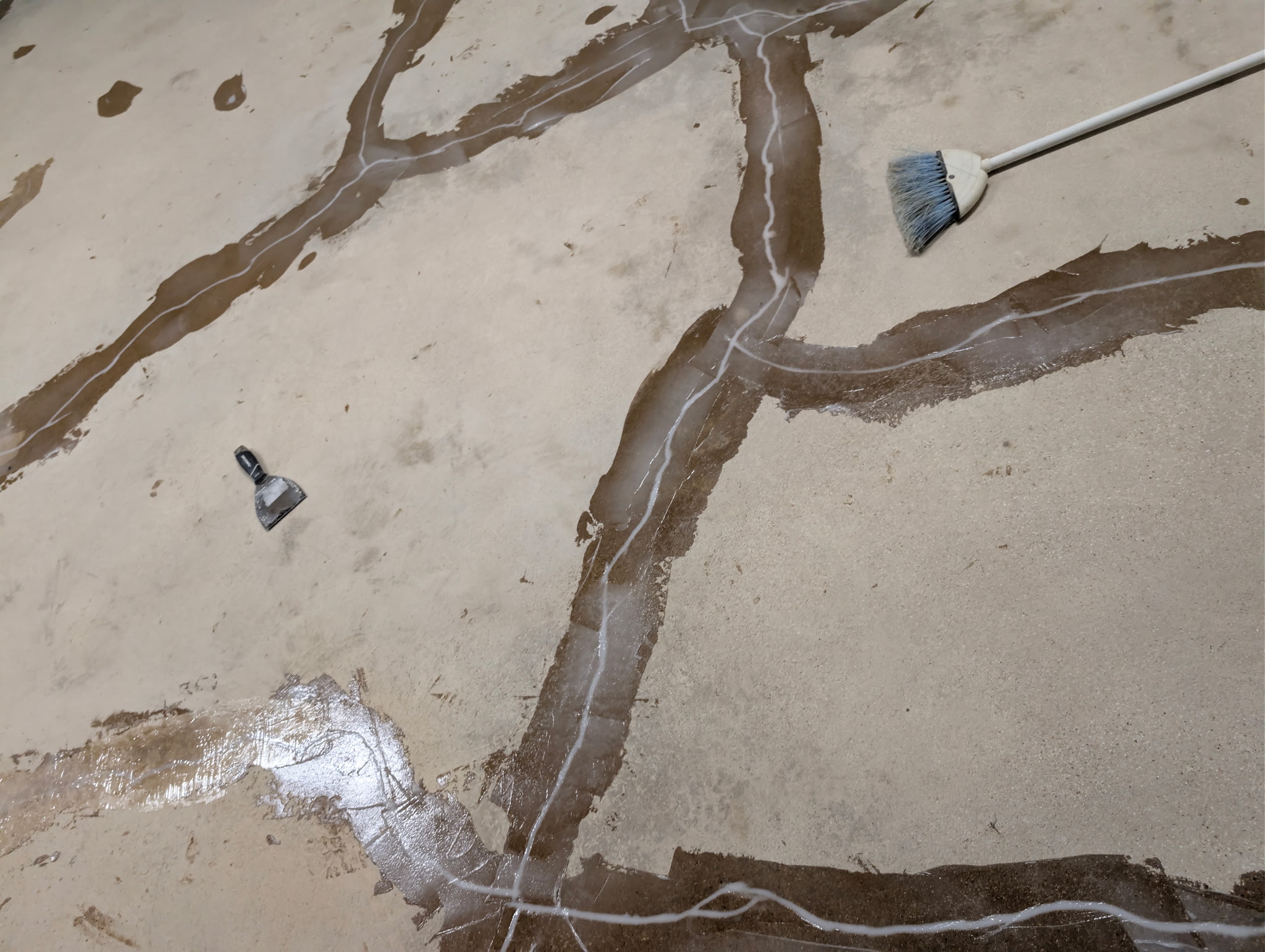
Carrollton splits neatly into two housing eras and each one asks a different question of a chip floor. The tract neighborhoods built through the seventies, eighties, and into the nineties, Old Downtown Carrollton, Indian Creek, the older streets around Castle Hills, sit on slabs that have already done thirty to fifty years of seasonal movement on Houston Black clay. That soil swells when it rains and shrinks when it does not, and it has spent decades pushing those slabs up and letting them settle back down. The result is honest working concrete: hairline mapping, control joints that have opened, sometimes a section that sits a few millimeters proud of its neighbor, plus whatever oil a couple of generations of cars left behind.
That is a chip floor’s ideal patient. We diamond grind the whole bay to open the pores, route out and structurally fill the cracks, level the joints flush, then broadcast to refusal over the repaired surface. On the same slab a solid color would be brutal, because a flat field of gray highlights every place the concrete profile changes.

The newer master-planned side of Carrollton brings the opposite problem. Those slabs are flat, clean, and sound, so prep scope drops and the quote comes down with it. What they carry instead is moisture: a slab poured in the last fifteen years may still be releasing vapor from below, and vapor pressure under a sealed coating is what lifts an otherwise perfect floor off the concrete in sheets. We run a moisture test before quoting any newer Carrollton build and spec a vapor-tolerant primer when the numbers call for one.
Heat, Tires, and Sunlight in a Carrollton Garage
A south-facing Carrollton garage clears 130 degrees on an August afternoon, and that number is the reason cheap coatings fail here in patterns you can predict. Two separate mechanisms do the damage, and a good system has to answer both.
The first is hot-tire pickup. A car coming off Josey Lane or the tollway in July parks with tire rubber near its softening point, plasticizer migrates into the coating where the tire sits, and when the floor cools the rubber grips it. Next time the car pulls out, the coating leaves with the tire in a patch the shape of the contact patch.
The second is ultraviolet light. Standard epoxy ambers under sunlight, and plenty of Carrollton garages have a window in the side wall or glass panels in the door, while a great many of our chip jobs here are sunrooms, covered patios, and pool decks where the sun runs the show. Aliphatic polyaspartic does not amber, so we spec UV-stable clear by default on every Carrollton install.
Why Chip Repairs Where Metallic Cannot
Customers ask us to compare these two constantly, and the honest answer has nothing to do with which one is nicer. They fail at opposite things. A metallic floor is a poured, flowing surface. Mica pigment moves through the resin while it levels and freezes into a pattern nobody, including us, can fully predict. That is the appeal. It also means a metallic floor is a single continuous field with no visual noise to hide behind, so anything happening underneath telegraphs straight through. A joint that later opens, a patched section that cures at a slightly different rate, a repair that reads a shade off, all of it shows. Metallic belongs on a sound, stable, well-behaved slab and we place it in Carrollton showcase garages and interior rooms where the concrete has earned that trust.
Chip is the opposite instrument. It is a mechanical pattern of thousands of discrete flakes, and pattern is camouflage. On the older Carrollton slabs where we do most of our chip work, that camouflage is doing real structural honesty a favor: we can properly repair a slab, routing and filling and leveling as the concrete actually needs, without the finished floor becoming a map of everywhere we worked. The repair is under there. You just cannot find it.

So the question we actually ask on a Carrollton walkthrough is what the room is for. A garage that stores two cars and a workbench and takes real use gets chip. A finished garage that a homeowner treats as an extension of the house, kept clean and mostly looked at, is a fair candidate for metallic epoxy. If you want the chip system across a whole garage build rather than a single bay, that is our garage floor coatings scope, and if what you actually need is a new clear over an existing sound floor, that is polyaspartic coatings.
What Install Week Looks Like Here
A standard two-car Carrollton garage on a sound slab runs two days on site. Day one is grinding, vacuum, crack and joint repair, primer, base coat, and the broadcast itself. Day two is sweeping the loose chip back, scraping the surface flat, and laying the clear. On an older slab with substantial repair work we add a half day, and that appears on the written quote before you agree to anything rather than arriving as a phone call halfway through the job.
You walk on it the next morning and park on it after about three days. Our quote turnaround in Carrollton runs about 48 hours from the call, and installs typically land two to three weeks out. We batch Carrollton jobs by neighborhood, so if your project lines up with a trip we already have booked, same-week scheduling is sometimes possible.
Every Carrollton chip floor is a fixed-price quote written after we have walked your actual slab, and it carries a written workmanship warranty. There is no honest square-foot number over the phone, because prep scope is the variable and prep scope is decided by concrete we have not seen. Send photos through the contact form and we will tell you which direction your slab is likely headed before anyone drives out.
Carrollton flake epoxy, priced before we start.
Photos of the garage get you a straight answer. The on-site visit gets you a fixed-price quote and a written warranty.
Carrollton Flake Epoxy Questions
How do I tell a full refusal quote from a partial broadcast quote?
Ask whether the crew returns the following day to sweep and scrape excess chip before the clear goes on, because a refusal broadcast always generates excess. Then ask whether the base coat color will show in the finished floor; on a refusal job it is completely buried. A single-day chip floor in Carrollton is a partial broadcast, whether or not the word appears on the paperwork.
My garage is a 1980s Carrollton tract house with cracks. Is chip the right call?
It is close to the ideal application. We route and structurally fill the cracks, level the joints flush, and broadcast over the repaired slab so the pattern absorbs the repair visually. The work still has to be done properly underneath, though. Chip hides a repair, it does not replace one.
Which chip size should I choose?
Quarter-inch suits most Carrollton garages, busy enough to disguise slab history and calm enough not to dominate a two-car bay. Half-inch reads bolder and architectural, and eighth-inch behaves more like texture than pattern, which suits interior rooms. We set blend boards on your own slab under your own lighting before you decide.
Will an August Carrollton garage pull the floor up under my tires?
Not with the clear we use. A south-facing Carrollton garage passes 130 degrees in August, and hot rubber softens thin acrylic clears until the tire grips and lifts the coating. We finish with a polyaspartic rated for continuous high-temperature service, which stays hard through that exchange.
Does my Carrollton floor need a UV-stable clear if it is inside a garage?
If any daylight reaches it, yes. Standard epoxy ambers under ultraviolet light, and a side window or glass panels in the door are enough to do it over a few seasons. We spec aliphatic polyaspartic on every Carrollton job by default, and for a sunroom, covered patio, or pool deck it is not optional.
Can you coat over the kit floor already in my Carrollton garage?
No. A rolled-on kit was almost certainly acid etched rather than ground, so it is clinging to a weak surface layer, and anything we build on top inherits that bond and fails with it. The old coating comes off mechanically, back to bare concrete, then the slab gets assessed on its own condition. Removal appears on your quote as its own line before you agree to it.
Other Carrollton Epoxy Work
Read how the chip system works across the whole region on our flake epoxy page, browse every service we run in this city on the Carrollton, TX page, or see the wider Dallas County coverage. Recent installs are in the gallery, and you can book a Carrollton walkthrough whenever you are ready.
Where We Work in Carrollton
Chip floors go down across the whole city, Old Downtown Carrollton, Hebron, Indian Creek, Castle Hills, and the rest of West and East Carrollton. We are 30 to 45 minutes from the Dallas shop depending on how the tollway is behaving, and Carrollton is a regular territory rather than a drive we make once. If your address is in Carrollton, we cover it.