Four things move the price of an Irving garage floor: what is already on the slab and what shape it is in, how much grinding and crack repair it needs, the layout of the room, and which system you choose. Nobody can see the first two from a phone call. That is why the real number comes from a site visit, written down as a fixed price.
Searching for a garage floor price usually turns up a spread so wide it tells you nothing, and the low end is almost always a kit or a crew that skips the grind. We do not publish a square-foot number, and we are not being coy about it. Two garages of the same size on the same street in Irving can need very different amounts of work, and a price that ignores that difference ends up wrong one way or the other. What we can do is explain what we are looking at when we walk your garage, so the quote you get makes sense line by line. If you know these drivers going in, you can also compare quotes from anyone and see which ones left something out.
Why an honest garage quote needs a visit
A photo shows color and clutter. It does not show whether the slab is holding moisture, whether that gray film is an old sealer, or whether a hairline crack is stable or still moving. Those are the things that change the amount of labor, and labor is most of what a floor is.
So the visit is short and specific. We look at the age of the slab, test for moisture, check for prior coatings, run a hand over the cracks and the joints, and measure. We also talk about how you use the garage, because the right system for a room with a workbench and a freezer differs from one for a showcase space.
Cody usually has a quote back to you within two days of the call. What you get afterward is a fixed price, itemized, with the prep spelled out. It is not a range and not a starting-at number with add-ons waiting. Cody would rather lose a job on a real number than win it on a low one and have the floor fail in two summers. You can read more about how we approach garage floor coatings around Irving on the service page.
What the slab brings to the number
The slab is the biggest variable, and Irving has a wide range of them. Newer construction, roughly anything poured after 2010, usually has a sound surface that grinds quickly. Outside Las Colinas, a lot of garages sit on mid-century slabs that have had decades of oil, paint, sealers and patching. Those need more grinding to reach clean, open concrete.
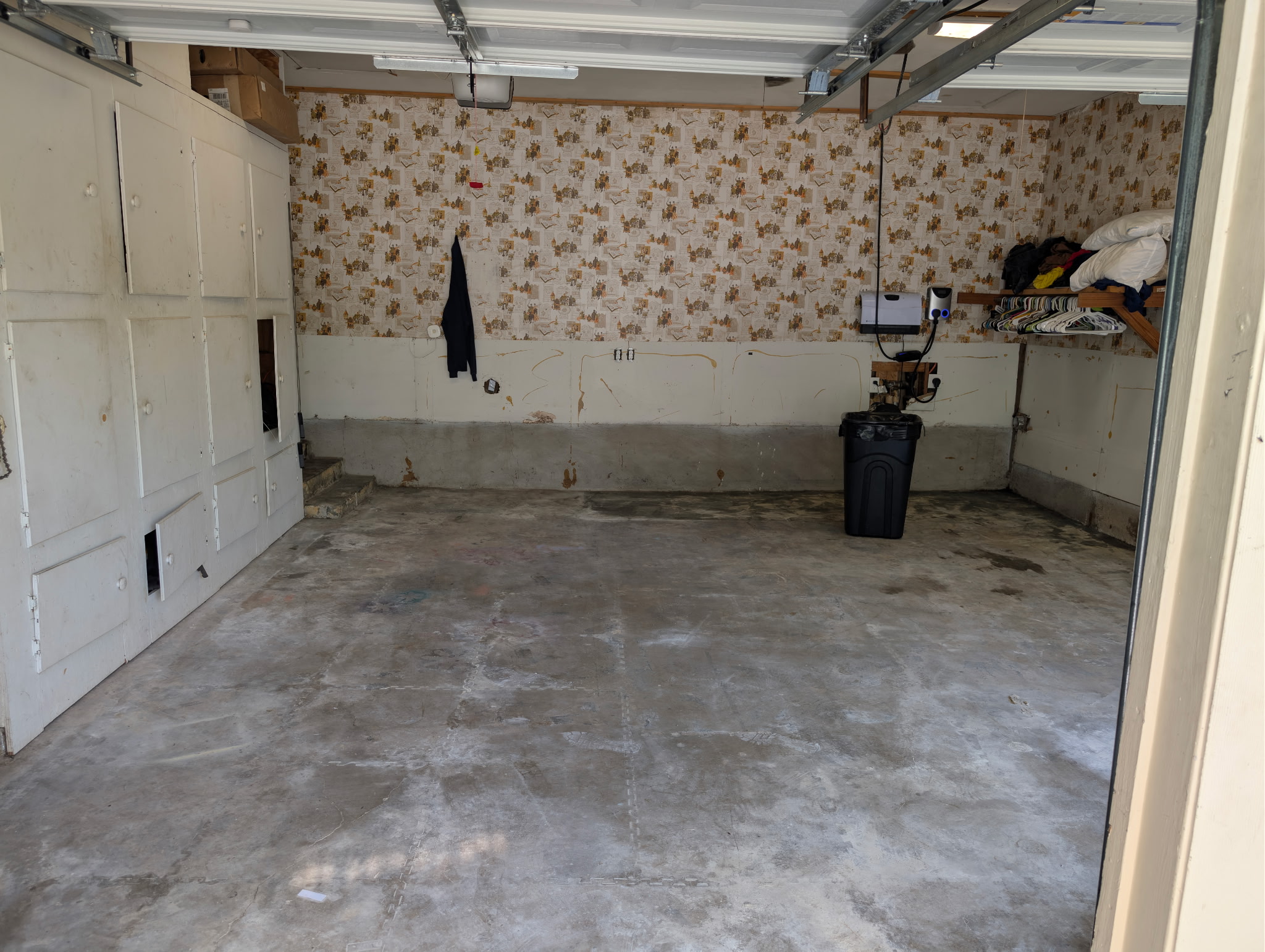
Old coatings add the most time. A roll-on kit that has started peeling has to come off completely, not just where it lifted, because the parts still stuck are sitting on the same weak bond. Oil soaked deep into the concrete sometimes needs extra treatment before a coating will hold over it.
Cracks are the other slab factor. Irving sits on clay that swells in wet months and shrinks in dry ones, and garage slabs crack in response. Each crack gets chased open and repaired mechanically, and the count and length of them show up in the labor. Moisture matters too. A slab pushing vapor needs a different primer approach, and it is far cheaper to learn that on day one than after a floor blisters.
Square footage is only part of the measurement
People reasonably assume a two-car garage is a two-car garage. The floor area is a starting point, but the shape of the room changes the work. Steps up into the house need to be ground and coated by hand on every tread and riser. The strip under the garage door track, the apron where the slab meets the driveway, drains, curbs along the walls and the edges around a water heater platform all take slower, detailed work than the open middle of the floor.
Built-in cabinets that sit on the slab are another one. We either coat around them carefully or the cabinets come off the floor first, and that choice is made at the visit. A garage with a lot of edge detail can take noticeably longer than a plain rectangle of the same size.
Clearing the room is part of the conversation too. The floor has to be empty for grinding and for the full cure, so anything stored in the garage has to live somewhere else for those days. We tell you exactly how long that is before the job is booked, so you can plan where the car, the freezer and the bikes will go.
How the system you pick moves the price
Once the slab and the room are understood, the finish is the remaining choice. A full-broadcast flake floor is the most common garage system we install, and chip blend and chip size have only a modest effect on the work. Adding a fine grit to the topcoat for grip adds a little material and almost no time.
Metallic floors take more labor per square foot. The pigment is worked by hand while the resin is wet, and it needs its own settling time before the clear goes on. That is skilled time, and it shows in the quote. Metallic suits a showcase garage better than a working one, and we will say so if your room points the other way.
The topcoat is the last variable. We finish garages with polyaspartic because it stays hard through an Irving summer in a closed garage and it does not yellow in sunlight. An epoxy clear is less material, and it is also the layer most likely to soften under a hot tire. We explain the difference in our polyaspartic coatings page for Irving, and flake epoxy has its own page too.
What a fixed-price quote should spell out
Whoever you hire, the paper you get should answer a few questions without you asking. What is the prep method, and does it say diamond grinding? Is moisture testing included? How are cracks repaired, and is removal of any old coating priced in? What system goes down, coat by coat, and what is the topcoat? How many days is the garage out of use? What does the warranty cover, and is it in writing?
Our quotes list those items separately so you can see where the work is. Prep, primer, base coat, broadcast or pigment work, topcoat and the final walk-through are all accounted for. When grinding exposes something a walk-through could not reveal, such as buried adhesive or a crack deeper than its surface suggested, we stop and show you before the scope or the price moves.
When a lower quote shows up, compare the prep lines first. An acid etch in place of a grind, no moisture test, or filler in the cracks will all bring the price down, and they are also the most common reasons a garage floor fails early. A flake system with a polyaspartic topcoat laid over a properly ground slab can give you 15 to 20 years in a home garage. Kits and shortcuts rarely come close.
Questions about garage floor pricing in Irving
Can you give me a rough number from photos of my garage?
Photos help us come to the visit prepared, and we are glad to look at them. They cannot show moisture, old sealers or how active a crack is, so the number we stand behind comes after we see the slab in person and write up a fixed price.
Does a big-box kit really save money over a professional floor?
It costs less on day one. Kits are thin, usually go down over an etch instead of a grind, and often lift under hot tires within a couple of summers. Removing a failed kit adds grinding time to the professional floor you end up buying anyway, so the kit tends to cost more overall.
Why would two garages the same size get different quotes?
Because the slabs are different. One may be newer concrete with nothing on it, and the other may have peeling paint, oil stains, several cracks and steps into the house. Grinding, repair and detail work make up most of the labor, and those change far more from garage to garage than the square footage does.
If you want a real number for your garage, call and tell us a little about the slab, then let Cody walk it. You will get a written fixed price with the prep itemized. Browse finished garages in our gallery, or reach us through the contact page.
A Firm Price for Your Garage Floor
Every garage we finish is backed by a written workmanship warranty.
Meet Cody at Your Slab (972) 369-6302What we install in Irving · Other Irving reading · Contact us