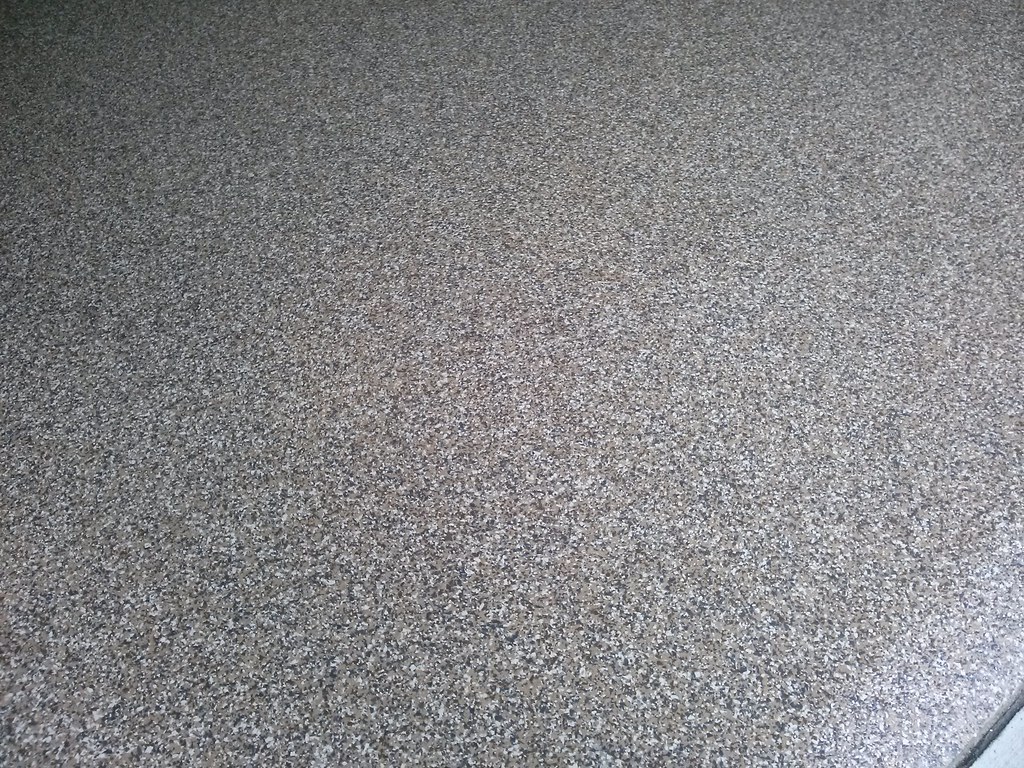
Coat the whole slab, then put rubber over the lifting zone. The coating is not the impact layer and was never meant to be. It is the sealed, cleanable, moisture-blocking surface that lives under your mats and around them, and it is the part that keeps sweat and chalk from soaking into concrete you can never scrub clean again.
Half the McKinney garages I walk into these days have a rack against the back wall and a car still parked in the other bay. Somebody clears out one side, orders a barbell and bumpers, and stands there looking at a dusty gray slab wondering what goes down first. Usually they call me after they have already bought the mats, which is backwards.
What Dropped Weights Actually Do to Bare Concrete
A loaded bar coming down on raw concrete does not crack the slab. What happens is spalling: the bar chips the surface paste, and once that skin is broken the concrete starts shedding dust every time you sweep. You end up with pockmarks in a ring around your platform and a floor that gets worse every session because nothing is sealing it anymore.
Bumper plates spread the load better than iron, but they still hammer the same spots hundreds of times. And the real damage is not the impact at all. It is everything that soaks in through those broken spots afterward.
The Coating Is Not the Impact Layer
I want to be straight about this because some installers will not be. Epoxy does not stop a 315 pound deadlift from doing what it does. Nothing you roll onto concrete does. If somebody tells you their coating is bomb-proof under bumpers, they are selling you something.
The coating seals the entire slab so it can be cleaned and cannot absorb anything. Then rubber goes over the lifting zone: horse stall mats, or interlocking gym tile if you want it tidier, and that stack takes the hit. The coating underneath takes the sweat and the daily wear on all the square footage the mats do not cover, which is most of the room.

Why Bare Concrete Under Mats Is the Real Problem
This is the part almost nobody thinks about, and it is the reason I push people to coat first. Concrete wicks moisture up from the soil underneath. Constantly. On an open slab it evaporates and you never notice. Put a rubber mat over it and that vapor has nowhere to go, so it collects between the rubber and the concrete.
Add the sweat that drips off you and works down through the seams, and you have a dark, damp, sealed layer sitting there in the dark. Pull those mats up after two years and you will find dark staining, sometimes a mildew bloom, and a smell that hits you from across the garage. I have lifted mats for people who had no idea, because the top side looked perfectly fine the whole time.
A coated slab does not do that. The resin is a vapor and liquid barrier, so nothing wicks up, nothing soaks in, and when you pull the mats to sweep underneath you get a floor that looks the way it did the day it went down.
Texture: Full Broadcast Beats Smooth
For a gym I run flake to full broadcast, meaning the chips go down until the base coat is completely covered, then it gets ground back and topcoated. That leaves a surface with real tooth to it. Smooth metallic looks incredible in a shop or a showroom, but it gets genuinely slick when it is wet, and a gym floor gets wet constantly.
Think about what you actually do outside the platform. Burpees with your hands flat on the floor. A rower sliding around. Sled work, jump rope, stretching, carrying a dumbbell across the room with damp hands. Every one of those wants grip. Full broadcast flake gives you that without being so aggressive it tears up bare feet or shreds a knee. The flake epoxy systems we install in McKinney are the same ones I would put in my own garage for exactly this reason.
The other thing flake buys you is that it hides everything. Chalk dust, a little dirt, tire marks on the parking side. A solid dark floor shows every speck. The chip pattern breaks it all up visually, which matters more than you would think in a room you use every single day.

Chalk, Sweat, and Spilled Pre-Workout
Chalk is the easy one. On a sealed floor it sweeps up or wipes off with a damp mop and it is gone. On bare concrete it works into the pores and turns into a permanent white haze you will never fully get out.
Sweat matters more than people expect, because it is salty and mildly acidic and it sits there until somebody wipes it. Concrete drinks it in. A coated floor does not, so it wipes off and the story ends there.
Texas Summer in an Uninsulated Garage
By July a McKinney garage with no insulation is running well past a hundred degrees by mid-afternoon. The coating itself does not care. A properly installed, fully cured resin floor handles that heat all day without softening, ambering, or letting go, and it handles the hot tires of the car in the next bay too.
Floor First, Then Everything Else
Do the floor before the mini-split, before the wall storage system, before the rubber goes down. There is a real reason for the order.
Grinding concrete throws a tremendous amount of fine dust. You do not want that happening after a mini-split head is mounted on the wall with its coils exposed, and you do not want it settling into a fresh drywall job. The floor install also needs the bay empty and open so I can run equipment cleanly along the walls and get a real edge instead of a compromised one.
So: clear the bay, coat the slab, let it cure, then hang the mini-split, mount the racks, and lay the mats last. Cracks or a peeling old coating get addressed during prep, not papered over. Bring me the plan for the room and I will tell you honestly what the concrete is going to allow. Take a look at what these floors look like finished over in our project gallery, or send us the details of your garage and we will go from there.
Garage Gym Floor Questions
Can I put rubber mats straight on top of a coated floor?
Yes, and that is the right way to do it. Let the floor fully cure first, then lay your mats. Pull them up every few months to sweep underneath and the floor below will stay in great shape.
Should I coat under the mats or only the open area?
Coat the whole bay. The area under the mats is the part that most needs a moisture barrier, since trapped vapor and sweat have nowhere to escape. Skipping it is the mistake that causes staining and mildew down the road.
Does summer heat hurt the floor in an uninsulated garage?
Not the coating. A cured resin floor takes Texas summer heat and hot tires without softening. Your rubber mats will get soft in that heat, so plan for a fan or a mini-split if you train through August.
Half Gym, Half Garage, One Good Floor
XPS certified, 10+ years of resin craftsmanship, and no rushing a slab that is not ready.
Coat My Floor Talk to Us: (972) 369-6302See our McKinney flake epoxy page · More posts · Coat my floor